
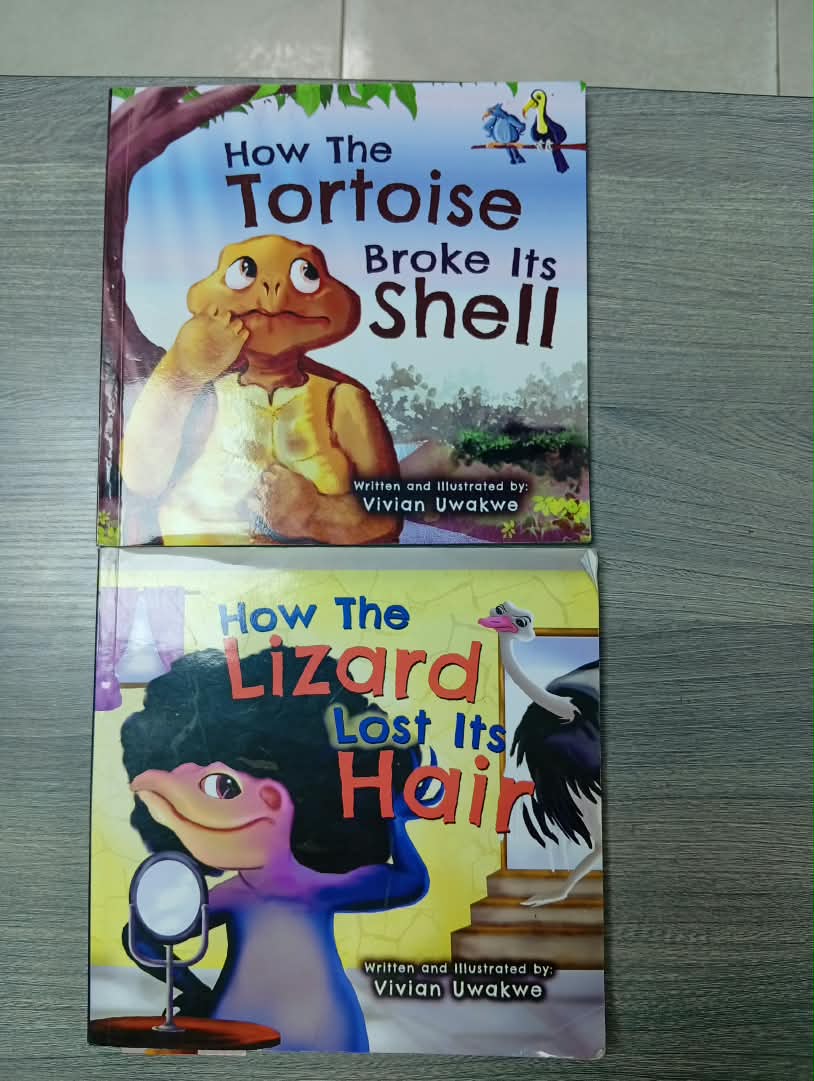

Title: How the Lizard Lost Its Hair: An African Folktale and How the Tortoise Broke His Shell
Author: Vivian Uwakwe
Reviewer: Ozolua Uhakheme
Publisher: Yanga Toons Limited
Pagination: 44/56
Not many authors feel comfortable writing for the teen because unlike books for adults, it comes with a unique creativity. Vivian Uwakwe’s two books: How the Lizard Lost Its Hair and How the Tortoise Broke His Shell are reminders of the great children books by some famous authors such as Beatrix Potter, who created gentle animal-centred English village tales led by The tale of Peter Rabbit and Julia Donaldson, a British author famous for rhyming animal stories like The Gruffalo. With this effort, Uwakwe is heading towards etching her name on the global literary space as an emerging children books author of note.
How the Lizard Lost Its Hair (Told Like an African Folktale) is a children’s story and activity book written and illustrated by Vivian Uwakwe. The book was launched at Alliance Française de Port Harcourt during a live reading attended by over 100 pupils.
The book tells the story of Agoku, a vain lizard who wants to keep his hair looking good. His actions introduce young readers to lessons about contentment and the consequences of stealing.
One of the book’s strengths is its presentation. Its glossy pages, colourful illustrations and readable fonts make it visually appealing and easy to follow. Although not all animals were individually named, the illustrations make them easy to identify, helping young readers connect with the characters.
The author also adopts an African folktale style and uses African names, giving the story a cultural identity that young readers can appreciate. The questions included in the book make it interactive, encouraging children to think about the story rather than simply read it.
Overall, How the Lizard Lost Its Hair combines storytelling, visual appeal and interactive learning. Its simple presentation and moral lessons make it a suitable read for children, while its African storytelling approach offers an opportunity to appreciate indigenous storytelling traditions.
For How the Tortoise Broke His Shell, by the same author, is a children’s story book that retells an African folktale in an interesting way. The story follows Mbe, a curious tortoise who admires how healthy and happy the birds appear. Seeking to discover their secret, he approaches his friend, Angulu the vulture.
In his quest to enjoy the same benefits as the birds, Mbe devises a plan to fly with them. Three strong birds—Shadow the Hawk, Awodu the Falcon and Ugo the Eagle—carry him in a net to the land of plenty. Interestingly, this version differs from the familiar folktale in which the birds give the tortoise their feathers to enable him to fly.
The story teaches children about the dangers of greed, selfishness and deceit. Its inclusion of familiar Nigerian foods also introduces young readers to aspects of their cultural heritage. Like the first book, How the Tortoise Broke His Shell is also glossy, durable, easy to carry and features readable fonts and clear illustrations. With fewer than 45 pages, it includes questions that encourage comprehension. It also comes with an activity book containing colouring pages, puzzles, crosswords and other engaging activities.
Overall, How the Tortoise Broke His Shell combines storytelling, cultural education and interactive learning, making it an engaging choice for young readers.
As an illustrator, Uwakwe allows visual to tell better part of the stories rather than overwriting the text. She also confines herself to the appropriate use of vocabulary and sentences that match the age group that is her target audience.
Beyond entertaining the children with folklores or fantasy, she uses images of animal and their stories to convey strong moral lesson in very few words.
Uwakwe is a Nigerian children’s book author, talented self-taught artist and speaker who takes pride in her African heritage. She is on a mission to document all the stories her father, a fantastic storyteller, told her as a child.
In 2022, she won a $1000 scholarship to SPMS a I2-wee workshop run by accomplished Children’s book authors: April Cox and’ Bobbie Hinman.
Ever since, she has been creating African folktales and original interactive children’s storybooks as well as activity books in simple modern language with beautiful, vibrant illustrations to catch the minds of young kids around the world. African folktales are usually full of humour but end up teaching a moral. Storytelling among several African tribes around the continent, are typically told by the village griots as well as the elders. The young listeners pass on the torch by retelling these stories from generation to generation. Other African folktale in this series is Why The Spider Lives In A Web.