

Winning first prize at an international exhibition in London is no small achievement for any artist. For Yusuf Seidu Okus, however, the recognition carries a significance that goes beyond the award.
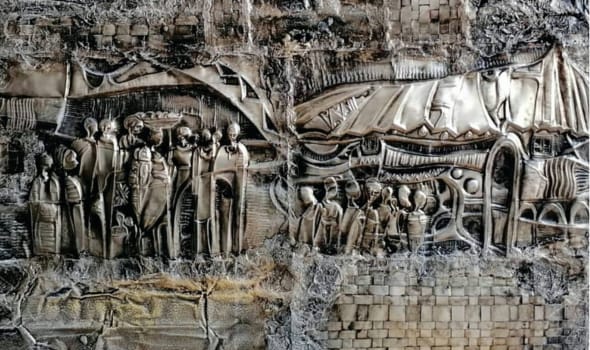
His aluminium metal foil artwork, Adulterated People, emerged as the first-prize winner at the October 2026 Taking Liberties open call, an exhibition that brought artistic attention to migration, detention, freedom and the dignity of human life.
At The Foundry in Vauxhall, London, where the exhibition opened on 15 October, Okus found himself among artists and individuals engaging with some of the difficult realities of migration and displacement.
His work, alongside Peace Accord, was selected by the judges for recognition and inclusion in the exhibition. It was a welcome moment for an artist whose practice has consistently explored the relationship between art and the issues confronting society.
For those who have followed his artistic journey, this latest achievement is another chapter in a story of experimentation, persistence and social engagement. From aluminium foil and discarded plastics to community art workshops in Coventry, Okus has continued to explore how materials, images and creative encounters can communicate ideas that deserve a wider audience.
The exhibition was organised in connection with Migrants Organise and Bail for Immigration Detainees (BID), organisations whose work engages with the experiences, rights and dignity of migrants and people affected by immigration detention.
The choice of subject was particularly relevant to Okus, whose artistic interests extend beyond the physical appearance of an artwork to the human experiences and social realities behind it.
The recognition certificate presented by the Taking Liberties Exhibition Steering Group acknowledged him as the Taking Liberties Open Call Award Winner, with Adulterated People and Peace Accord selected by the judges for a prize and inclusion in the 2026 exhibition.
The exhibition opening brought together artists, invited guests and members of the public for an evening of conversations, poetry, music and shared experiences.
For Okus, it was an opportunity to connect with other creative minds and engage with people who understand that art can do more than occupy a wall. It can question, challenge and sometimes make uncomfortable truths difficult to ignore.
The exhibition remains open for viewing until January 2027, giving visitors further opportunities to encounter the works and the issues they explore. This latest recognition is accompanied by another honour.
On 24 October 2026, Okus received a Certificate of Award from Settlement Support CIC and its partners at the Annual Minorities Youth Expo and Community Awards Programme, held in celebration of Black History Month.
The award recognised his outstanding contribution to Arts, Culture and Community Resilience.
Presented by the organisation’s Founder and Coordinator, Byron Taylor, alongside Co-Founder Kofi Folson, the recognition adds another dimension to his growing profile. It acknowledges the value of his artistic activities beyond the gallery and the contribution of creative practice to community life.
Perhaps this is where the different parts of Okus’s journey begin to make more sense. His interest in art has never been limited to producing objects for exhibition. He has consistently explored ways through which creativity can encourage participation, promote understanding and bring people together.
His engagement with the Herbert Art Gallery and Museum in Coventry, United Kingdom, offers a good example. His two community art workshops at the institution in 2025 formed part of the museum’s Open: Studios for Social Wellbeing Programme Development Project.
The workshops, Plastic Upcycling: Studio for Social Wellbeing and Extraordinary Junk Chicken Collage Creating, took place on 25 March and 25 April 2025. They were developed within a wider programme involving the museum and Warwickshire Virtual School, with particular attention to unaccompanied asylum-seeking children.
Using discarded plastics and other accessible materials, the sessions encouraged participants to explore their imagination, develop confidence and interact with others through creative activities. It was an opportunity to discover that art does not always require expensive materials, elaborate equipment or even a common spoken language. Sometimes, a shared creative activity is enough to begin a conversation.
The accompanying exhibition of his original works at the Herbert Art Gallery and Museum further demonstrated the possibilities of his practice. Works such as Ageing is Golden I, Eruption I, Known Face, Clustered and Scream, all produced through plastic collage, revealed his continuing interest in transforming discarded materials into compelling visual expressions.
His exploration of surfaces and material combinations is also evident in Flora Garden (2022) and Help is on the Way (2022), both executed in acrylic on gold foil. Earlier pieces such as Homeward Bound, Mama’s Love, Affection 5, Drummer’s Display 5 and Flutist (2021) demonstrate his willingness to explore materials beyond the familiar canvas.
Another work identified in the museum’s programme documentation is Boundaries We Create, described as plastic on plastic. Its title offers an interesting point of reflection within a wider body of work concerned with the relationship between materials, human experiences and the environments we inhabit.
Looking at these works, it becomes clear that Okus is not simply interested in finding alternative materials for conventional artistic processes. He is exploring how those materials can influence the character, texture and meaning of an artwork. Plastic, aluminium foil and gold foil each offer different possibilities, and his willingness to experiment with them has become an important part of his practice.
There is also an interesting Nigerian chapter to this story. At the 2021 Sculptors Association of Nigeria (ScAN) Exhibition, his aluminium metal-foil artwork, More Housing, attracted the attention of renowned Nigerian artist Professor Bruce Onobrakpeya, who acquired the work for his private collection. The acquisition was an important endorsement of Okus’s creative ingenuity and his ability to find artistic possibilities in unconventional materials.
It is worth remembering that artists do not always receive recognition at the same time or through the same channels. Sometimes, an artwork finds its audience years after it leaves the studio. In this instance, the acquisition of More Housing remains a notable moment in a career that has continued to develop across different cultural environments.
For Okus, the environmental conversation remains equally important. In a world struggling with waste management, pollution and the consequences of careless consumption, his practice offers another way of looking at the materials around us. What we discard may still have a useful purpose. What we consider ordinary may possess possibilities we have not yet explored.
Beyond the materials and the finished artworks, however, there is a deeper motivation behind his practice. He is interested in what happens when art brings attention to issues that might otherwise remain unnoticed, whether they concern environmental degradation, social injustice or the treatment of people who require psychological and psychiatric support. For him, the artist’s responsibility does not end with producing an artwork; there is also the question of what that work communicates and the conversations it leaves behind.
Technology and easier access to information have changed the way we understand our immediate environment. Issues that were once confined to particular communities can now reach audiences across geographical boundaries.
Artistic practice has equally benefited from this expanded reach. Okus believes that art addressing real human and environmental concerns can become a starting point for wider public discussion.
As he explains, “every real work of art, especially work that talks about issues that people face – of environment, especially, – they generally spark a discourse, which actually leads to some kind of policy formulation eventually”.
This belief is reflected in his determination to take difficult subjects beyond the places where they originate. By presenting these experiences to a wider audience, he hopes to encourage empathy among viewers who might otherwise never have considered the circumstances or conditions affecting other people. In this sense, his art becomes more than a visual statement; it becomes an invitation to listen, understand and possibly act.
Looking ahead, Okus hopes to continue exhibiting his works across different platforms and cultural spaces. He also has an ambition to establish a place where communities, migrants and non-migrants alike, can come together to learn, share experiences and discover new possibilities through art. It is an ambition that brings his artistic interests, community engagement and belief in the social value of creativity together.
There is a lesson in his approach.
Art does not always begin with expensive materials or conventional expectations. Sometimes, it begins with the ability to look at familiar things differently. For Okus, the discarded becomes a resource, the overlooked becomes a subject and the artwork becomes an invitation to a conversation.
His journey continues, carrying with it the possibilities of new materials, new audiences and new cultural encounters. From Nigeria to Coventry and London, Yusuf Seidu Okus is finding ways to make his artistic voice heard, reminding us that creativity can give discarded things another life and forgotten human experiences another voice.