

By Ozolua Uhakheme
What happens when the things we have grown accustomed to overlooking are moved to the centre of our view? For the artist Vivian Nnajiofor, in her pieces Boundless Together, Two Ways of Seeing, and Held with Love, plastic, bottle caps, buttons, and pieces of fabric that are typically relegated to the category of waste are transformed into compositions about humanity, difference, and belonging. It is not only an environmental message that emerges from the transformation of these materials; rather, it is a metaphor for Nnajiofor’s larger interest in the way society assigns value to objects, to bodies, and to minds.
Nnajiofor’s art practice oscillates between paintings and assemblages; however, the latter depend very much on the actual physicality of the found materials. Their scuffs, imperfections, and histories are visible. By allowing the viewer to recognize the origins of the materials, Nnajiofor creates an interesting tension between the materials that were once disposable but are now arranged, saved, and contemplated carefully.
In Two Ways of Seeing, the dichotomy of the transformation of waste into a thoughtful composition is expressed through a dual portrait divided into two contrasting halves. The left side of the picture is made mostly of black buttons, while the right side explodes with transparent fragments and buttons of all sorts of colours and shapes. Even though they contrast, they both create one face.
Two Ways of Seeing is a very effective work of art precisely because of its capacity to show not only the contrast, but also the coexistence of two experiences. Nnajiofor does not present the viewers with two separate portraits, she challenges the habit of understanding neurological difference through the lens of a hierarchy of the normal and the other. Instead, difference becomes a part of building the complete human identity.
There is, however, a productive tension created by the representation of the two kinds of minds as a dichotomy of simplicity and richness of colour and visual experience. While such contrast is powerful, it can run the risk of making the mind that has been represented in black seem ordered and the colourful one appears chaotic. The statement accompanying Nnajiofor’s work makes it clear that it is not the case. Two Ways of Seeing is especially effective when its visual variety is read not as disorder but as a demonstration of the impossibility of reducing human experience to just one pattern.
In Held With Love, Nnajiofor moves from representation of identity to care. A bright heart made out of bottle caps floats between two open hands that are made of transparent plastic bottles. The message is quite clear and almost emblematic; the hands do not grip or restrain the heart; instead, they make space for it.
Such a gesture is very important. Nnajiofor represents acceptance not as the process of correcting some deviation but as readiness to embrace it without trying to control it. Colours that fill the heart represent the differences in people’s ways of thinking and perceiving the world.
The use of material and message go especially well together in Held With Love. Plastic bottles, items that are often crushed and discarded without giving any thought to their potential, are transformed into hands that are able to hold something valuable. Thus, Nnajiofor connects the ideas of environmental and social disposability and, instead of suggesting any comparisons of humans to garbage, questions the mechanisms of perception that determine what is worth caring for.
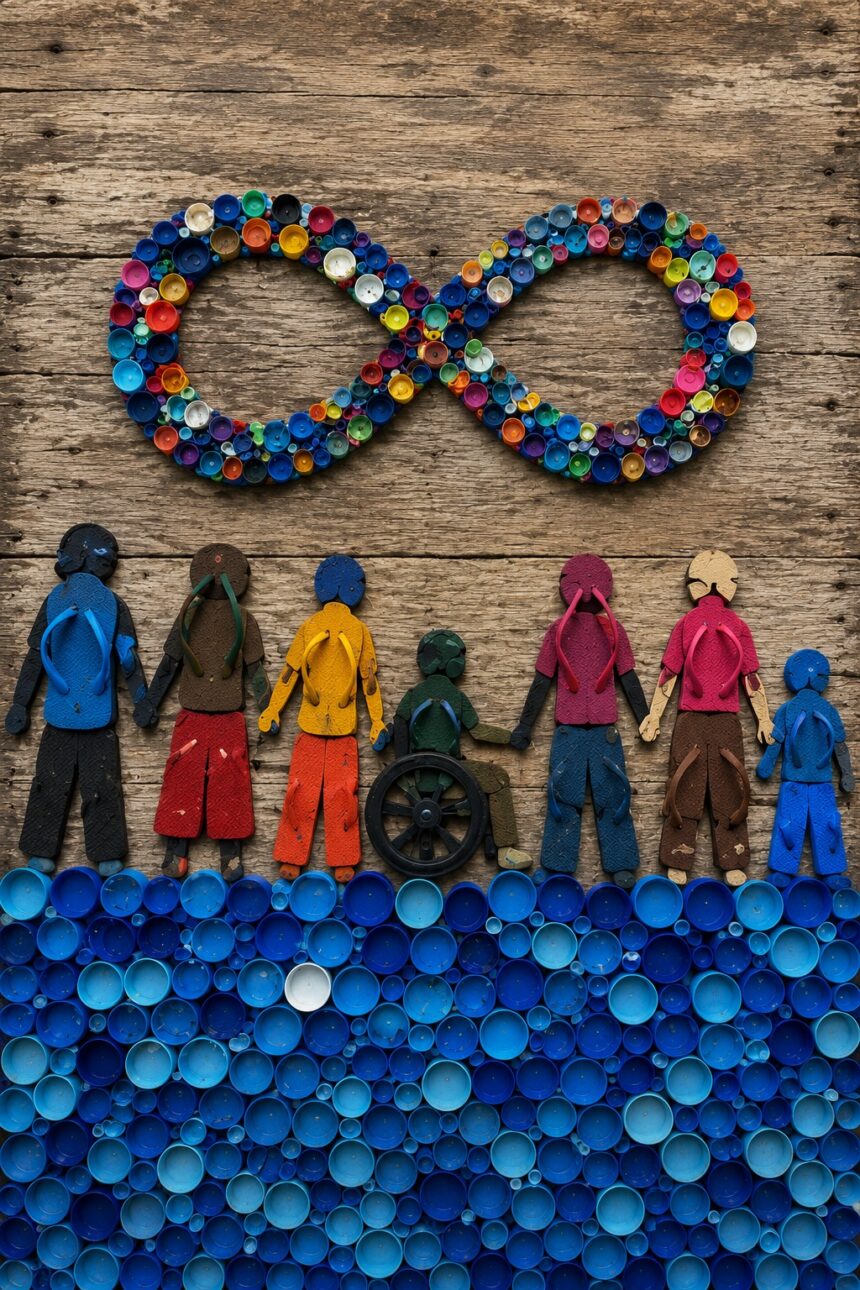
While the main ideas presented in the composition Boundless Together expand the concept of Held With Love into a community, the key element of this piece is that none of the figures presented there represents the community as a whole. Differences in colours, forms, sizes, and disabilities exist in the same visual plane.
The infinity symbol, presented in Boundless Together, is a key point of this piece. Human possibilities should not be determined by the limits imposed by society on difference. On the other hand, Nnajiofor uses discarded materials multiple times throughout her compositions, thus repeating the theme of transformation.
It is precisely what sets Nnajiofor apart. In addition to the subject matter, sustainability is present in the creation of her artworks, as the materials are full of evidence of previous consumption even after having been transformed.
All three works are visually straightforward, and the symbolism is intentional and quite easy to comprehend. Their next step may be to move away from such clarity in order to add complexity, contradiction, and ambiguity into the discourse on disability and neurodiversity. This may help enrich a visual language that communicates its message clearly enough.
The question raised by Boundless Together is quite simple yet quite necessary: what becomes possible when difference is not treated as deviation?
The answer given by Nnajiofor lies in the process of transformation. Plastic becomes portrait, bottle caps become symbols of connection, and discarded objects receive new lives. Through this transformation, Nnajiofor presents the argument for a society where inclusion is not just accommodation, but recognition of difference as a part of the whole.