


By Zainab Olufemi, Moscow
From the grandeur of centuries-old cathedrals and the precision of presidential guards to the stirring sounds of traditional Cossack music, a cultural tour of Moscow on Sunday offered a glimpse into the history, traditions and cultural identity of Russia.
The cultural programme formed part of the official press tour of the Third Russia-Africa Summit and Economic and Humanitarian Forum, holding from October 25 to 30, in Moscow.
The cultural excursion offered participants an opportunity to explore Russia’s historical heritage and contemporary cultural life ahead of the summit. Through visits to the Kremlin and Red Square, the Presidential Regiment’s guard-changing ceremony and an evening concert by the Kuban Cossack Choir at the State Kremlin Palace, the programme combined historical exploration with exposure to Russian ceremonial and artistic traditions.
The day-long experience brought together some of Russia’s most prominent historical monuments and cultural institutions, offering visitors an opportunity to explore the country beyond its modern political identity. At the centre of the tour was the Moscow Kremlin, a fortified complex whose history spans centuries and still remains closely associated with the country’s political and religious development.
Accompanied by a tour guide, Kate, participants explored the historic complex, learning about the significance of its cathedrals, monuments, military traditions and buildings associated with the Russian presidency.
The experience provided a practical introduction to the historical developments that transformed Moscow from a medieval settlement into the centre of Russian state power.
Kremlin: A monument to Russia’s history
Situated at the heart of Moscow, the Kremlin is one of Russia’s most important historical landmarks. According to the United Nations Educational, Scientific and Cultural Organisation (UNESCO), the site was first mentioned in historical records in 1147 and became a centre of political authority and religious life during the 13th century.
Its present stone walls and towers were largely constructed between 1485 and 1516, creating the fortified architectural complex that remains one of the defining features of Moscow.
The Kremlin and Red Square were inscribed on the UNESCO World Heritage List in 1990 in recognition of their outstanding architectural and historical significance.
Over the centuries, the Kremlin served as a residence for Russian rulers, a centre of Orthodox Christianity and a setting for important political ceremonies. Today, it houses museums, historic churches and buildings associated with the Russian presidency.
During the tour, Kate explained the historical significance of the different structures, helping visitors understand how the complex evolved through successive periods of Russian history.
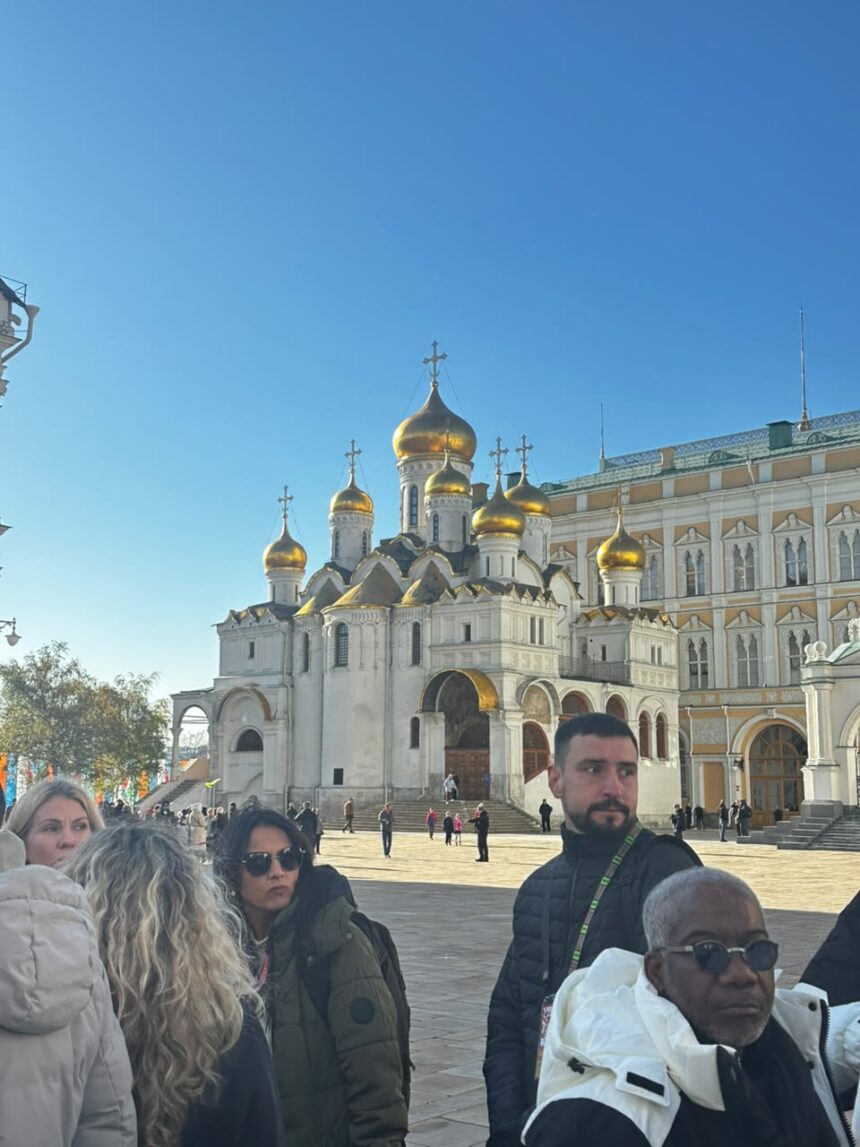
She said that one of the most remarkable features of the Kremlin is its Cathedral Square, which contains some of the country’s most important religious monuments.
The square includes the Assumption Cathedral, the Archangel Cathedral and the Annunciation Cathedral, each associated with different aspects of Russia’s religious and royal history.
“The Assumption Cathedral, completed in 1479, became a principal church of the Russian Orthodox tradition and the site of coronations and other major ceremonies involving Russian rulers.
Its interior contains historic frescoes and an elaborate iconostasis, reflecting the artistic and religious traditions that flourished under successive Russian rulers,” she said.
The Archangel Cathedral served as the burial place of numerous Moscow princes and Russian tsars, while the Annunciation Cathedral was closely associated with the religious life of the royal court.
Together, the buildings illustrate the close relationship between religion, monarchy and political authority in Russia’s past.
She added that the Kremlin also contains the Ivan the Great Bell Tower, which rises approximately 82 metres and was once the tallest structure in Russia.
The architectural ensemble reflects both Russian craftsmanship and the influence of foreign architects, particularly Italian masters who contributed to the development of the complex during the late 15th and early 16th centuries.
According to her, beyond its religious structures, the Kremlin contains monuments that reflect the country’s military history and imperial ambitions.
Among them is the Tsar Cannon, a monumental artillery piece cast in Moscow in 1586 by master cannon-maker Andrei Chokhov on the orders of Tsar Feodor Ioannovich.
Weighing approximately 40 tons and measuring 5.34 metres in length, the cannon is distinguished by its enormous 890-millimetre calibre.
Despite its imposing appearance, the Tsar Cannon was never used in warfare. It remains a striking example of historical metalworking and the monumental objects through which Russian rulers displayed authority and prestige.
The tour also provided a glimpse of the Senate building, which houses the official presidential workplace. Constructed between 1776 and 1787, the building was originally designed to accommodate the governing Senate of the Russian Empire.
Its continued association with the presidency illustrates the Kremlin’s enduring role in the administration of the Russian state.
The Kremlin’s significance, however, extends beyond government. Its churches, palaces, fortifications and monuments preserve different layers of the country’s history, making it both a political landmark and a repository of national heritage.
Presidential guards showcase military traditions
A major highlight of the visit was the mounted and foot guard-changing ceremony performed by the Presidential Regiment on Cathedral Square.
The ceremony showcased the discipline, coordination and precision associated with Russia’s ceremonial military traditions.
The Presidential Regiment is a special military unit within the Kremlin Commandant’s Service of Russia’s Federal Guard Service. Its responsibilities include supporting official state events and performing ceremonial duties at significant national occasions.
According to the organisers of the Spasskaya Tower International Military Music Festival, the regiment’s honour guard was established in 1976 and participates in the ceremonial mounting of mounted and foot guards at the Kremlin.
The unit also performs honour guard duties at the Tomb of the Unknown Soldier, including at the Eternal Flame, and participates in major state ceremonies.
The ceremonial guard-changing tradition brings together elements of military drill, music and horsemanship.
During the Kremlin performance, the mounted and foot guards demonstrated choreographed movements and military formations, offering visitors an opportunity to observe the precision required for ceremonial duties.
The horse-mounted component added another dimension to the spectacle, reflecting the historical association between cavalry and military pageantry.
The guards’ specially designed ceremonial uniforms also reflect historical influences. Some elements resemble the parade uniforms of the Russian Imperial Guard from the early 20th century, reinforcing the connection between contemporary ceremonial practice and earlier military traditions.
The performance illustrated how military ceremonies can serve not only official functions but also preserve historical symbols and practices.
For visitors, it offered a direct encounter with a tradition that continues to feature in Russia’s public and state ceremonies.
Red Square: At the heart of Moscow
The programme also included a visit to Red Square, the historic public space adjoining the Kremlin’s eastern walls.
Red Square is among Moscow’s most recognisable landmarks and has long served as a setting for public gatherings, ceremonies and major events in Russian history.
Its surroundings bring together architectural monuments from different periods, offering a visual account of the city’s political, commercial and cultural development.
One of its most distinctive features is St Basil’s Cathedral, officially known as the Cathedral of the Intercession of the Most Holy Theotokos on the Moat.
The cathedral was constructed between 1555 and 1561 under Tsar Ivan IV, commonly known as Ivan the Terrible, to commemorate Russia’s capture of Kazan.
Its colourful domes and distinctive architectural design have made it one of the most recognisable symbols of Moscow.
Red Square is also bordered by the State Historical Museum and GUM, the historic department store whose architecture reflects the city’s commercial heritage.
Lenin’s Mausoleum, another prominent landmark, represents the Soviet period and remains part of the square’s historical landscape.
The square and the Kremlin are recognised together as a UNESCO World Heritage Site, reflecting their interconnected significance in Russia’s political and architectural history.
A visit to Red Square therefore offers more than an opportunity to see famous buildings. It provides a perspective on how Moscow’s public spaces have evolved alongside changes in government, society and national identity.
Cossack choir celebrates 215 years of musical heritage
The cultural programme continued in the evening with a concert by the Kuban Cossack Choir at the State Kremlin Palace.
The performance was titled “We Are 215 Years Old!” and marked the 215th anniversary of the historic ensemble.
According to the State Kremlin Palace’s official programme, the anniversary production was designed to celebrate the musical traditions of the Kuban Cossacks through folk music, spiritual compositions, works by composer Viktor Zakharchenko and choreographed performances drawn from the choir’s repertoire.
The concert offered a musical dimension to the day’s exploration of Russian history, demonstrating how cultural traditions can preserve the experiences and collective memory of a community.
The Kuban Cossack Choir is one of Russia’s longstanding professional folk ensembles. Its history is linked to the military singing traditions of the Kuban Cossack Host, a Cossack community whose history is closely associated with the Kuban region in southern Russia.
Cossack communities developed distinctive musical traditions encompassing folk songs, religious chants, ceremonial music and performances reflecting their social and historical experiences.
These traditions have been transmitted through generations, with music serving as a means of preserving language, regional identity and collective memory.
The anniversary concert drew on this heritage through a programme combining traditional and contemporary elements.
The official programme highlighted Cossack folk compositions, spiritual songs and works by Zakharchenko, alongside choreographic performances from the ensemble’s established repertoire.
Such performances illustrate the relationship between music, dance and storytelling in folk traditions. Through songs and staged movement, audiences encounter historical experiences and cultural values that may otherwise remain confined to written records.
The choice of the State Kremlin Palace as the venue added significance to the occasion. Located within the Kremlin complex, the palace is a major venue for concerts, performances and official cultural events.
The evening performance complemented the daytime tour by moving from the physical monuments of Russian history to the music and artistic traditions through which communities continue to express their identity.
Culture as a window into national identity
The day’s programme brought together three different ways of exploring Russia’s heritage: architecture, ceremonial practice and music.
At the Kremlin, historic cathedrals and monuments reflected the development of religious and political authority. The Presidential Regiment’s guard-changing ceremony demonstrated the preservation of military traditions through formal performance. At Red Square, the architectural landscape revealed successive layers of Moscow’s history.
The Kuban Cossack Choir’s anniversary concert offered a different perspective, showing how music and dance continue to carry regional traditions into contemporary cultural life.
Together, the experiences demonstrated that a country’s history is preserved not only in monuments and official institutions but also in ceremonies, artistic expression and the practices passed from one generation to another.
For visitors, the programme provided an opportunity to encounter these traditions firsthand and to understand the historical context behind some of Moscow’s most prominent landmarks.
From the Kremlin’s centuries-old walls to the sounds of Cossack folk music at the State Kremlin Palace, the October 25 programme offered a journey through the architectural, military and cultural heritage that continues to shape Russia’s national story.