


By Ozolua Uhakheme
There are some kinds of wealth that cannot be measured. They can be inherited, remembered, transmitted, and carried forward from generation to generation. In AJÉ – The Currency of the Ancestors, Adeife David revives the cowry once used as material currency across some parts of West Africa, giving it new value. Worn in braids, traced in the shapes of complex hairstyles, and passed down through generations, it acquires new significance, one tied to memory, identity, beauty, knowledge, and belonging.
Hair turns out to be one of the main visual carriers of that concept in this series. Instead of viewing it as pure decoration, Adeife makes it into a live archive. Intricate braids hint at the knowledge embodied in hands and passed down through practice, while the cowries act as markers within this archive. Both of them make the body a carrier of history, not only its remembrance.
Through six black-and-white photographs, this idea develops gradually. Children and adults appear as heirs, bearers and preservers of cultural knowledge. Braids wind, rise, intersect and descend, gaining in some cases almost architectural character. Among the deep monochrome tones, pale cowries punctuate those structures as markers on the path of knowledge, reminding us that value can persist even when the meaning of an object changes.
The series starts with the symbol of material wealth but leads to a more complicated question: if currency shows us what a society values, what is happening when the things of greatest importance cannot be bought or sold?
For Adeife, the answer is in what survives in the course of inter-generational transition.
In The Inheritance, the very presence of a child makes that journey begin. Her sophisticated hairstyle appears almost bigger than herself, hinting at the weight and richness of the cultural heritage before she can understand it. And culture always comes to us earlier than we can name and explain it. We inherit traditions, gestures, names, aesthetic codes and the way of seeing the world long before we understand its origins.
As the series goes on, the subjects start acting as bearers, not just recipients of cultural knowledge. The Bearer of ÀJÉ is one example of that development: the complex coiffure rises behind the woman’s head almost like a crown. The hairstyle takes up a lot of visual space but the woman herself is not overpowered by it. Her facial expression and overall presence are still central here.
It is quite important for this series. Adeife is not photographing just hairstyles here but people carrying knowledge.
In Where Currency Becomes Memory, the face completely disappears. Seen from the back, the head becomes a field of carefully organized braids with cowries marking the ends of each of them. Without a face to capture your attention, you are encouraged to study the construction itself.
In this photograph, the idea of hair as archive becomes especially strong. Each braid implies the process: someone has known how to divide the hair into sections, create patterns, and reproduce techniques he or she has learned from somewhere else. Cultural memory, therefore, exists not only in material objects and historical documents but also in hands, gestures and practices.
The recurrent cowry acts as the conceptual link between all these photographs. Historically associated with material exchange, Adeife relocates the shell from an economic system into a cultural one. Its meaning changes. What was once counted represents the things that cannot be easily measured: identity, beauty, dignity, memory and belonging. It allows AJÉ to ask its most important question: What do we consider wealth?
Adeife’s answer is not the simple assertion of the importance of the past. Instead, the photographs show that wealth is created through continuity. Something persists because it is worn, practiced, reinterpreted, and given to the other person.
The black-and-white treatment reinforces this sense of continuity. Without the colors, Adeife emphasizes the form and texture of his photographs: dark braids among pale shells, patterned fabrics among the skin, smooth surfaces among the details. Monochrome also gives this series visual consistency, making the six photographs function as one piece of art rather than isolated portraits.
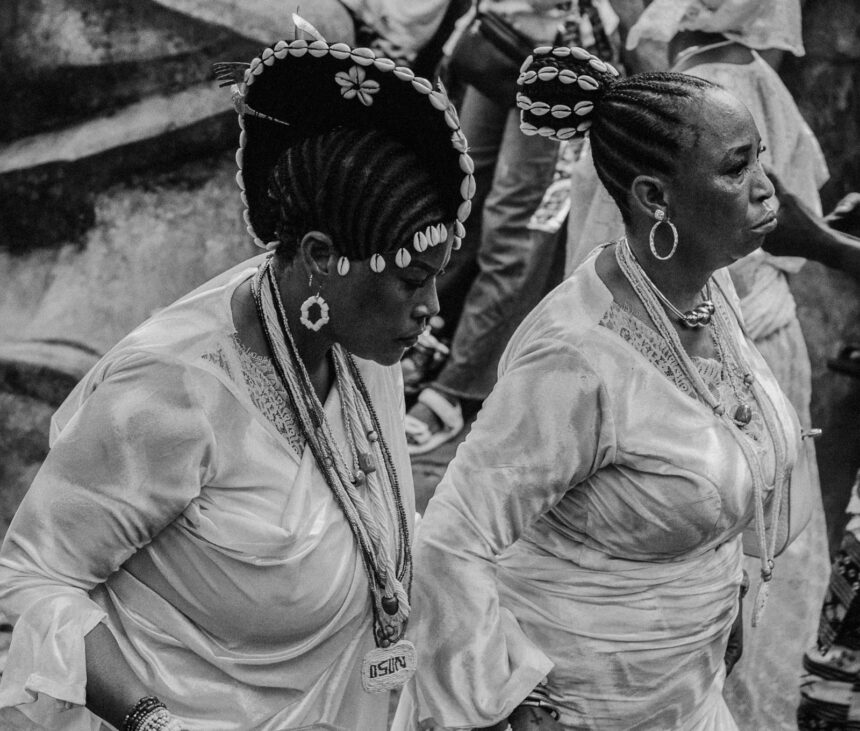
The Currency Between Us expands the project from the question of individual identity to the concept of collective memory. With two women in the frame, the inheritance is no longer shown as the possession of one person. It becomes a relationship.
This is an important step in the development of the series because culture cannot exist through one person alone. It is transferred between people: from parents to children, elders to younger generation, artists to apprentices, friends to friends, and through communities.
It is one of the areas that Adeife could explore further in his work. Because AJÉ is focused on transmission, future development of the project could go beyond the finished hairstyles and show the process of creating them: hands braiding hair, attaching cowries, one generation teaching another. Such photographs will prove that cultural preservation is not a passive process. It requires labour, knowledge and participation.
The beauty of AJÉ lies in its ability to transform familiar visual elements into a dialogue about cultural value. Adeife’s photographs are strong when they allow hair, cowries and the human body to communicate without interpreting their symbolism too much.
This series could use more historical specifics about the traditions and histories being referred to, especially because cowries had different meanings for different African cultures. It will enrich rather than limit the work. Still, AJÉ is successful because it does not treat the tradition as something static and frozen in time.