


The Home series has a lot of common household items such as a grand piano, two teacups and an intricately decorated mirror. Although the series doesn’t contain any people, the composition suggests that people have been in the scene recently, currently or soon will be.
The Hone series by Remilekun Adedayo Ibitoye looks at everyday items and overlooked areas of the home. Through this she uses a monochrome palette to create contrast within her images. The series includes; Conversation Over Tea, The Music That Remains, Reflections Of What Was, The Door We Leave Open, Where Love Continues To Bloom and The Quiet Language of Home.
It creates a feeling that the home contains evidence of humans due to the use of specific lighting and compositions. The lack of colour helps to draw attention to the reflective surfaces of the furniture, the shadows and interaction between light and darkness.
The image, Conversations Over Tea, has been thoughtfully composed to create a sense of organisation but without it feeling stiff. The flowers take up most of the middle of the image but the two cups on the right create a sense of friendship. The rough fabric hanging off the table softens the shiny surface.
The most eye-catching part of the image is the large shadow of the window. This creates a realistic sense of afternoon light without showing much of the room. The image works well as the sense of a human connection has been created through the composition of items in the image.
The Music That Remains: This image has a more dramatic composition. It contains a grand piano which dominates the image. The dark shiny surface of the piano contrasts with the shadows surrounding it. The piano stool is empty in the foreground with a spotlight on the open music sheet and small bouquet of flowers. This creates a tension within the image. The lack of a person playing the piano is more evident in this image.
The dramatic lighting works well but makes this one of the more staged compositions. By not playing the piano it makes the viewer think about what sound and activity would usually be in the room.
The artist’s treatment of light becomes especially interesting in Reflections of What Was. The image depicts a highly decorated mirror (oval shape) hanging on a plain wall. The wall is cut up with sharp shadows from the windows. Instead of the reflection showing a person or an object with furnishings, it shows a reflection of the light itself.
The mirror is decorated which creates a contrast with the plain background. This is a minimalist piece which helps to create a focal point. Ibitoye has not added any extra imagery within the reflection, which gives the photograph a focal point due to the blankness.
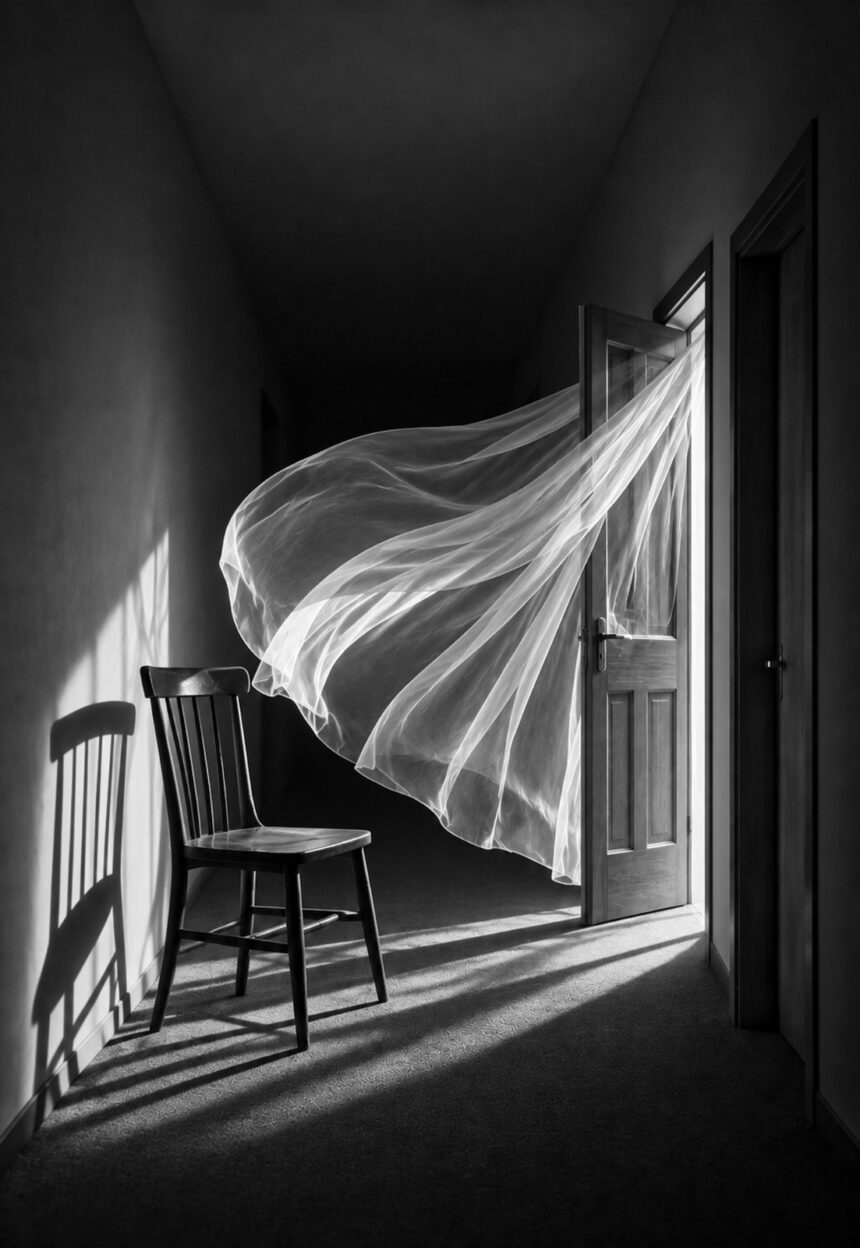
In The Door We Leave Open a doorway has been left open, there is a wooden chair and a length of transparent material appears to be in motion. This gives the image a greater sense of movement than the still mirror.
The fabric flows over the doorway creating a disruption to the clean lines of the room. It creates a light feel to the image due to its contrast with the solid chair and dark room. This image has the most movement within the series, and allows more of an open interpretation. The open doorway could represent leaving, arriving or just the flow of air in the empty room. The still furniture in the image creates a strong sense of time passing.
Where Love Continues to Bloom contains a curved floor lamp that is shining down onto a bunch of roses placed into a large textured vase. The light source creates a focus on the flowers by casting them in shadow against the dark wall. The rounded floor lamp, round vase and uneven edges of the flowers create a nice composition.
There is less ambiguity with the symbolism in this image. Flowers are commonly associated with care and love. This means there is less mystery in this image than others in the series. However, it shows Ibitoye has thought about how the objects interact with the shadows.
Light is a main feature within each of these images. It draws our attention to certain areas, creates depth between different elements and makes the everyday locations feel special. The use of black and white helps create unity within each image.
Within her work it seems like Ibitoye is very interested in creating the suggestion of human presence through the use of light. This is achieved well through the lighting on the piano, table and chair. This shows us that there has been activity within the home.
However there are some limitations. Although the strong directional lighting, staged objects and empty scenes help create a unique visual, sometimes the images feel more like staged images. This series works best when the composition can be interpreted in a way that has some ambiguity. If there was more variety with the lighting and composition it may help.
The Quiet Language of Home is interesting as Ibitoye has taken an everyday scene and focused on what is left behind. Although the subjects aren’t out of the ordinary the arrangement of the items in the scene makes you wonder how they were used, what memories they hold and who occupied the space.
Her best photographs refrain from answering these questions and allow each space to be empty whilst trusting the viewer to see some humanity in the scene.
Remilekun Adedayo Ibitoye has shown that you don’t always need to include people in your images of home. Sometimes the objects they have left behind can be the most telling.