


Yinka Shonibare’s name reverberates across the global art world, far beyond Nigeria’s borders. He is an artist with ears to the ground and his head up in the sky. Not only is he an accomplished artist with an intimidating profile, his longstanding engagement with colonialism, cultural identity, and post-colonialism also places him in a very hallowed sphere, a rare privilege many artists can only dream of. Simply put, his résumé thunders.
Whenever he speaks, the art world listens. In 2024, Shonibare further cemented his place in the annals of contemporary art when he unveiled Monument to the Restitution of the Mind and Soul as part of Nigeria Imaginary, Nigeria’s presentation at the 60th Venice Biennale, adding yet another milestone to an already illustrious career decorated with prestigious honours, including the title of Member of the Order of the British Empire (MBE). The monumental installation was made from clay, steel, plywood, cement render, fibre glass, glass, wood and acrylic paint.
That imposing work, a towering pyramidal structure, carries dozens of clay replicas of objects looted from Benin during the British Expedition of 1897. Shonibare’s own website describes the work as replicating 153 objects and says it was intended to confront the enduring consequences of British colonialism, the scale of the theft and the continuing debate over restitution. That important intervention rightly attracted international attention.
However, despite Shonibare’s gravitas, despite his larger-than-life status in the art world and the reputation he has built as an artistic giant, that reputation is about to melt like a cube of sugar in water, not thanks to the controversy currently roiling the global art community. Shonibare is at the heart of a controversy over intellectual property rights triggered by his monumental installation, Monument to the Restitution of the Mind and Soul. Following the international acclaim that greeted the installation at the 60th Venice Biennale, the work eventually travelled from Venice to Benin City, where it was presented in connection with the Museum of West African Art’s Nigeria Imaginary: Homecoming exhibition.
But the homecoming itself went awry. It became complicated by a controversy over not just the museum’s opening and protests in Benin City, but also something equally important: the monumental installations. That controversy is a peculiar irony that now shadows Shonibare’s Monument to the Restitution of the Mind and Soul. Visitors, on seeing what Shonibare had installed at the Venice Biennale, noticed a strange similarity between his work and Prof. Peju Layiwola’s monumental Benin1897.com: Art and the Restitution Question, an ambitious exhibition that opened at the University of Lagos in 2010 and later travelled to the University of Ibadan.
They observed that Shonibare’s work was not entirely new, drawing parallels with an installation Layiwola had created 14 years earlier. They believe that when one places Shonibare’s work beside Layiwola’s Benin1897.com, certain visual and conceptual echoes become difficult to ignore.
Layiwola’s 2010 exhibition was also unusually ambitious in its intellectual reach. It generated discussions involving artists, academics, lawyers, culture workers and government officials, while its 216-page catalogue contained contributions from African and Africanist scholars. The Smithsonian Libraries and Archives independently records the exhibition and its catalogue as a 2010 publication and exhibition project.
That exhibition was followed by years of research and artistic interventions. In 2014, she initiated Whose Centenary?, bringing together artists, performers, poets and photographers in Benin City to interrogate the meaning of Nigeria’s centenary celebrations and colonial memory. Long before the restitution debate gained its current international prominence, Layiwola had already emerged as one of its most incisive and committed artistic voices.
An accomplished artist, academic, art historian, curator and granddaughter of Oba Akenzua II, she has devoted a substantial part of her artistic and scholarly practice to the history of Benin, the 1897 British invasion, the looting of the kingdom’s treasures and the enduring question of restitution. Her artistic practice has repeatedly returned to questions of memory, colonial violence, cultural ownership and the meaning of objects displaced from their original contexts. Her own account of her work describes history as playing a major role in her choice of materials. She identifies Benin1897.com as a major turning point in her artistic and scholarly trajectory.
Not simply an art show, Layiwola’s exhibition was an extended artistic and scholarly interrogation of the British punitive expedition of 1897, the destruction of Benin City and the looting of thousands of objects from the royal palace. She created an installation of approximately 1,000 terracotta heads, using clay, animal horn, paper, beads, brass and copper. Her stated purpose was to engage with the history of the 1897 British expedition, the looting of Benin’s royal treasures and the questions of identity, copyright and ownership surrounding those objects.
Still, it is glaring that both artists are connected by their engagement with similar themes and discourses. Both artists turn to the same historical trauma. Both recreate or re-present Benin objects rather than simply displaying historical photographs or documents. Both employ clay or terracotta as a significant material. Both transform replicas of displaced Benin objects into contemporary installations. And both make the absence of the original objects part of the meaning of the work. But the similarity extends beyond subject matter.
The resemblance is not confined to the historical subject. It extends to the use of clay and terracotta, the multiplication of heads and objects, the monumental accumulation of forms, the installation strategy and the conceptual preoccupation with restitution. And when you place the objects in question side by side, the many similarities call for concern. But it is also instructive to note that, although Shonibare addresses issues of colonialism, he had never worked on Benin or within this framework before Venice.
Now, despite the gravity of the controversy, it’s all quiet on the Western front. Profound silence has taken over the art world. Artists, writers and critics are talking in hushed tones. Nobody wants to stir the pot. Both artists, Shonibare and Layiwola, have maintained a muted silence. They have refused to make public statements concerning the strange similarity between the two installations. Shonibare himself has ignored earlier reports.
Yet, the controversy is as stubborn as it is earth-shaking. It has refused to be swept under the carpet. It keeps rearing its head. The questions many are asking are: Why is there a striking resemblance between Shonibare’s and Layiwola’s works? Is it mere coincidence, or is there something more to it? Does it have to do with intellectual property rights, the provenance of ideas, and who holds the copyright to a work of art?
The questions raised by the comparison are substantial enough to warrant serious examination, particularly given that both artists have produced significant works engaging with colonialism, cultural memory and restitution.
One fundamental question many are also asking is whether Shonibare was aware of Layiwola’s work or had seen it before creating his monumental installation. If he had seen the work, the question of whether it influenced his artistic conception inevitably arises. And if he was influenced by Layiwola’s work, why was it not acknowledged? However, available evidence suggests that Shonibare was indeed aware of Layiwola’s work.
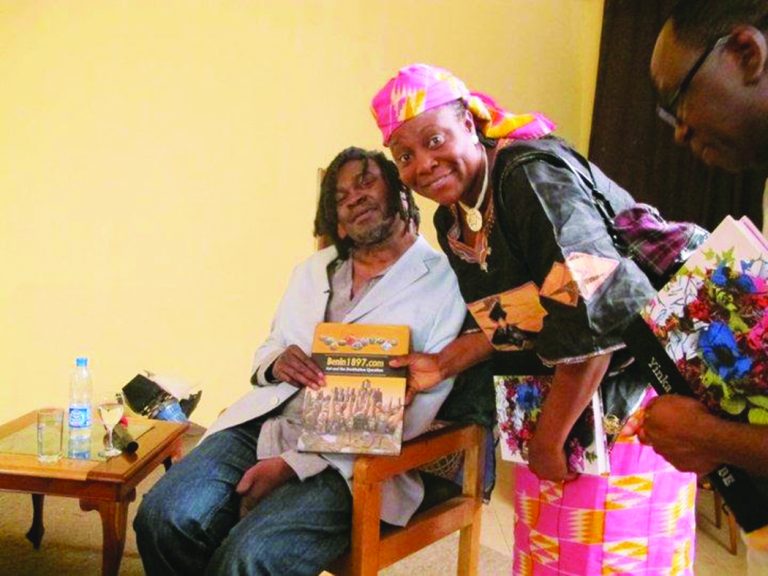
This is another element that makes the controversy more complicated. A photograph exists of Layiwola presenting Shonibare with a copy of her publication documenting her work on the Benin restitution question at an event at Terra Kulture in Lagos in 2011. The event itself is independently documented: Shonibare’s 2011 Art-iculate lecture at Terra Kulture was attended by members of Lagos’s visual-art community, including Layiwola. Layiwola also encountered Shonibare again in November 2023 at Art X, and they exchanged pleasantries shortly before his Venice work appeared. That also means Shonibare knew her.
That photograph establishes that Shonibare was aware of Layiwola’s work, even though it does not prove that Monument to the Restitution of the Mind and Soul grew directly out of her work. But it does establish something equally important: the issue of whether a work that echoes so many of Layiwola’s conceptual and material strategies should reasonably have acknowledged that proximity. And that is where acknowledgement becomes important. Should Layiwola’s pioneering work have been acknowledged in discussions surrounding Shonibare’s installation if, as the available evidence suggests, he was aware of it?
Acknowledgement is not an admission of plagiarism. It is an act of intellectual generosity. Had Shonibare said, in an interview, catalogue essay or public conversation, that his engagement with Benin existed within a field of artistic inquiry that included Layiwola’s Benin1897.com, the conversation might have been entirely different. He would still have his work. She would still have hers. .
Still, the irony is that both artists have championed restitution through art. Now they are at the centre of a controversy over restitution, not of Benin Bronzes but of something equally important: the provenance of ideas. Yet the controversy takes on an almost painful irony, given that Shonibare’s installation is about restitution. The work asks what it means for objects taken from Africa to return to the place from which they were violently removed. It challenges the history of European museums possessing African cultural treasures and proposes an alternative visual monument to those histories. The artist’s official statement says the work calls for repatriation and recognition of the historical, aesthetic, spiritual, and cultural significance of the looted objects.
But restitution is not only about objects. It is also about memory. And memory requires attribution. If an artist who spent years developing a visual language around the Benin question is omitted from the genealogy of a later work that appears to echo that language, then the irony is obvious: a work about recovering what colonialism took away may simultaneously participate—however unintentionally—in making another artist’s contribution less visible. That is the philosophical centre of this controversy.
The debate surrounding Shonibare’s monument therefore raises a larger question about recognition in contemporary African art. If an artist spends years excavating a historical wound, developing a visual vocabulary around it and bringing that work into public consciousness, what happens when another artist later produces a celebrated work that appears to travel through some of the same conceptual and material territory?
The question becomes even more compelling because Shonibare’s monument has acquired an international platform. Its Venice presentation placed the work within one of the world’s most important contemporary art events. It subsequently became part of the continuing public conversation around Benin restitution. The issue, then, is not about denying Shonibare his place in the history of restitution art.
It is about remembering that histories do not begin when they become internationally visible, and that long before Venice, there were Lagos, Ibadan and Benin—places where Layiwola’s work had already travelled and raised similar questions about restitution. Against this backdrop, Shonibare’s work cannot be discussed without also considering Layiwola’s earlier work.
This brings us to the issue of fairness and social justice. And if restitution is about social justice and giving credit where it is due to cultures and people whose work has been overlooked, then we should not, in the process, strip a contemporary female artist of the credit for her own work. For decades, the restitution debate has asked European museums to identify the provenance of African objects. Where did this bronze come from? Who made it? Under what circumstances was it acquired? Was it purchased, exchanged, looted, or taken by force? Who has the right to possess it?
Those questions are now transforming museum practice. But contemporary art needs a similar discipline. Where did this idea come from? Who explored it first? Who developed its vocabulary? Who made it visible? Whose research made the conversation possible? And who received recognition when that conversation entered the global art market? If provenance matters for objects, it should matter for ideas too.
The controversy surrounding Shonibare’s and Layiwola’s works ultimately asks an uncomfortable question that extends beyond both artists: Can we demand that museums return stolen African objects while remaining careless about the intellectual histories behind the ideas used to tell the story of that theft? The answer ought to be no. Because restitution that restores objects while erasing the people who helped us understand them is only half restitution.
And perhaps the most important lesson from the controversy is that an artist does not become smaller by acknowledging another artist. Quite the contrary. Acknowledgement enlarges the work. It places it in conversation with those who came before. It gives the idea a genealogy. And in a field increasingly preoccupied with provenance, perhaps the provenance of an idea deserves the same seriousness as the provenance of a bronze.
Beyond questions of fairness and justice, another dimension that merits attention, and which many have raised, is gender: a globally recognised male artist producing a major work that closely echoes that of a female artist with far less international visibility. Art history has not always distributed recognition equally between men and women. Women artists have frequently had their contributions absorbed into larger narratives dominated by male artists, curators, institutions and collectors.
While that does not prove discrimination, the question is worth asking because art history has not always distributed recognition equally between men and women. Women artists have frequently had their contributions absorbed into larger narratives dominated by male artists, curators, institutions and collectors.
One artist has the pavilion. Another has the footnote. One gets the museum wall. The other gets the archive. One becomes the global reference point. The other is described as an “influence.”
That distinction can, indeed, determine how history is eventually remembered.
Courtesy PM News