

ACETNEWS
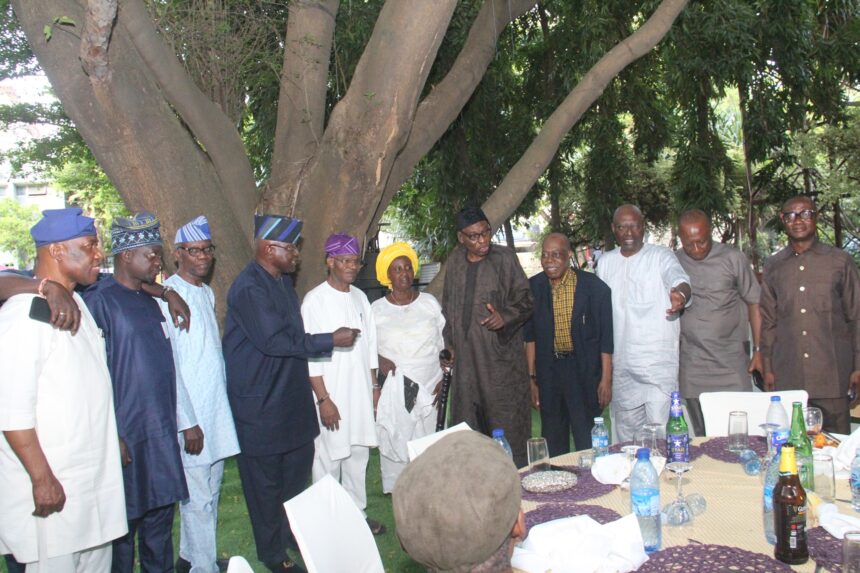
There was an unmistakable air of nostalgia, warmth and fellowship at the open arena in Freedom Park, Broad Street, Lagos on Sunday evening Some of Nigeria’s most distinguished journalists gathered to celebrate one of their own and former Editor Evening Times, Ben Lawrence, who clocked 90 few days ago.
The evening was a reunion of old friends, colleagues and kindred spirits bound by a shared passion for the pen profession. It was more than a birthday bash as it witnessed a meeting of generations of journalists- where decades of newsroom memories, professional practices and enduring friendships converged to honour a man whose life has spanned decades of Nigerian media history.
Among seasoned journalists at the gathering were Dare Babarinsa, Lanre Idowu, Nosa Ogiebor, Ray Ekpu, Dr. Yemi Ogunbiyi, Muyiwa Adetiba, Kunle Ajibade, Eniola Bello, and Martins Oloja. Others were Nigerian Guild of Editors President Eze Anaba, Dr. Kabir Alabi Garba, Steve Ayorinde, Gbemiga Ogunleye, Rose Moses and Gbenga Okegbenro.
In the midst of the reflections and reminiscences, Lawrence reflected on his journey in journalism, offering a rare glimpse into the experiences, values and defining moments that have shaped his nine decades of life and his years in the profession.
In particular, he is unhappy with the state of Nigeria and the journalism profession he devoted his life to. In this interview, he reflects on the values that shaped his generation, the challenges of reporting under successive governments, and why he believes journalism has lost some of its rigour, courage and sense of responsibility.
On his life and career at 90
I don’t want to lie to you. I can’t do some of the things I did five years ago. I was a very mobile person. In my youth, I was a pop crawler, and I was not alone. Most journalists were pop crawlers. That didn’t stop us from reading.
We have gone through many stages. I remember looking at people like Nnamdi Azikiwe and Obafemi Awolowo and thinking they would never die. They are no longer with us. As human beings, we are only passing through this life. I think the only things we should leave behind are a good name and a contribution that makes the world better than we found it.
State of the nation
If I tell you I am happy today, I will be a liar because this is not the country we worked for. Quote me; I am prepared to face any backlash. Look at some of the people occupying positions of authority across the country. Some are jesters and political houseboys, people who seem incapable of independent thought.
Thinking now appears to be an offence. People no longer seem to consider the consequences of their actions. In our days, we thought about what might happen if we did something and how it would affect another person. That sense of responsibility appears to be missing.
We have lawless leaders and lawless lieutenants, and the journalism profession has been greatly diminished. Those who are still standing may be doing so because of their discipline.
Today’s journalism versus the old
You are among the luckiest people in the world. You have the internet and all kinds of facilities that we did not have in our time. We had to observe strict deadlines and make arrangements with the Post Office to transmit our stories over long distances. We used what we called collect cards.
Yet, if something happened in Sokoto at midnight, the telephone would carry the news. I don’t know whether the same commitment exists today, despite all the facilities available.
The methods were crude, but the work was done properly. Even from a place like Nguru, a reporter could send in a correct story. That is the professionalism we are talking about.
Today, reporters seem confined to the routine of ‘He said, he said’. There are so many newspapers now, but the quality of reporting remains a concern. In our time, we were few, and perhaps that made us more protective of our jobs. We served under colonial rule, military administrations and democratic governments, and we shook this country.
As a journalist in a colonial rule, military government or democracy
It was easier for me to practise journalism under military administration. Why? Because if I published a story I knew to be true, I was prepared to face the consequences. They could not easily attack you when they knew you had your facts right.
Even under Decrees 4 and 2, we published earth-shaking stories.
Let me tell you something. On May 13, 1966, the front page of the Sunday Times was left blank. It was the day of the Northern Riot, which followed widespread killings in the North. The Daily Times had the story, but management directed that it should not be published.
The editor of the Sunday Times at the time was Peter Osugo, popularly known as Pecos. He was a fearless man who had been jailed in 1950 for his role in the Zikist movement. He was an outstanding student at St Gregory’s College and a record-holding athlete. He had intended to study engineering, but chose journalism despite his father’s opposition. That was the kind of courage and commitment we had in those days.
Unpublished story due to government pressure
I remember an incident during General Olusegun Obasanjo’s regime. The government had established the Nigerian Television Authority (NTA) and the Federal Radio Corporation of Nigeria (FRCN), but the agencies had no enabling decrees to give them legal backing.
At the end of the month, salaries were prepared for their staff. When the payments reached the banks, the banks reportedly refused to process them because the institutions did not legally exist. Announcing the establishment of an agency did not automatically make it a legal entity. That was the standard of adherence to the rule of law at the time.
I sent reporters to both organisations, and they returned with no comments from their managements. I wrote the story for the front page of the Evening Times, reflecting the responses from all sides, including the ‘no comment’ from the NTA and FRCN.
Unfortunately, Jaja told me to remove the story. I asked how we would fill the space and suggested that another story be used instead. I had a newspaper to sell, so I replaced it with a sports story.
That incident tells you something about the professional standards of the banks and institutions in those days.
Nigerian civil service
I don’t think there is any more civil service in Nigeria in the sense we knew it. In those days, if you went to court as a reporter and covered judgments delivered by judges such as Taylor, the quality of the legal reasoning and the language used could inspire you to improve yourself.
The standard of English, the depth of thought and the logic were impressive. Many factors have contributed to the decline we see today. That is why I am unhappy.
Growing up as an athlete
I am not as strong as I used to be. I was an athlete and a footballer. I played for Ibadan in 1957 as a left winger. We had association football then, not club football as it is organised today.
Peter Enahoro played right half-back at the time, while Sam Amuka, the publisher of Vanguard, was also a left winger. He was nicknamed Peggy because he was a short player.
We were active and strong, and we had good people to look up to. We had leaders who motivated you to aspire to their standards and even surpass them. Who do I want to emulate today? These jokers?
Message to journalists
I love my profession. I was already writing for Defender in Ibadan and the Tribune while I was still a clerk. I want reporting to be brought back to journalism. Reporting is no longer what it used to be. Many things are happening that the public does not know about, and journalists have a responsibility to uncover them.
That is what journalism should be about: finding out what is happening, establishing the facts and informing the public. We must recover that commitment if the profession is to regain its standing.