

ACETNEWS
On Sunday, a solo exhibition of recent works by Dr. Deola Balogun, Culmination: Linking Then and Now opened at the Metropolitan Club, Kofo Abayomi, Victoria Island, Lagos, one of the rare venues that serves as a meeting point for social activities of members. The artist’s decision to hold his solo at Metropolitan Club seems deliberate and strategic. The exhibition organised by The Adeline Gallery, will remain open till November 14. Balogun is a contemporary Nigerian multidisciplinary artist and senior art lecturer at the Yaba College of Technology, Lagos.
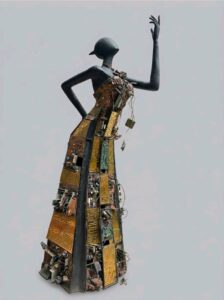
His ongoing exhibition, Culmination: Linking Then and Now is a body of work that interrogate ancestral lineage, history, social consciousness, and the digital frontier. By integrating the intricate geometries of electronic circuit boards and conductive track lines into sculpture and mixed-media painting, using transposed images of my previous sculptures and Gelede masks, Balogun seeks to map the invisible currents that define contemporary existence through the lens of Yoruba cosmology.
These technological motifs are not merely aesthetic choices; they function as a profound metaphor for Ilà, traditional Yoruba tribal marks and scarification prominent on Gelede masks, re-imagined as contemporary cultural allusions.
To Balogun, in Yoruba tradition, tribal marks serve as a sophisticated semiotic system: signifiers of heritage, protection, and social belonging. “I view the “tracks” of a circuit board as a modern form of scarification. Just as the blade once etched history and identity onto the skin, technology now etches its presence onto the body of our society. This “digital scarification” interrogates how our cultural identities are reconfigured, encoded, and sometimes distorted by the rapid pace of technological advancement.
“The application of these conductive pathways across my sculptures and canvases highlights critical tensions, notably between technological infrastructure and cultural heritage. I explore the rigid, non-negotiable logic of a circuit, where a single broken track leads to system failure; as a metaphor for our fragile social structures. My work examines systemic “glitches” in our political, social, and economic environments, particularly within the African context, where technological promise frequently clashes with infrastructural challenges. By applying these technical elements to tactile mediums like sculpture and multiple-mediums painting, I attempt to “flesh out” the coldness of electronics, transforming mass-produced, industrial symbols into intimate, hand-wrought expressions of human struggle and resilience.”
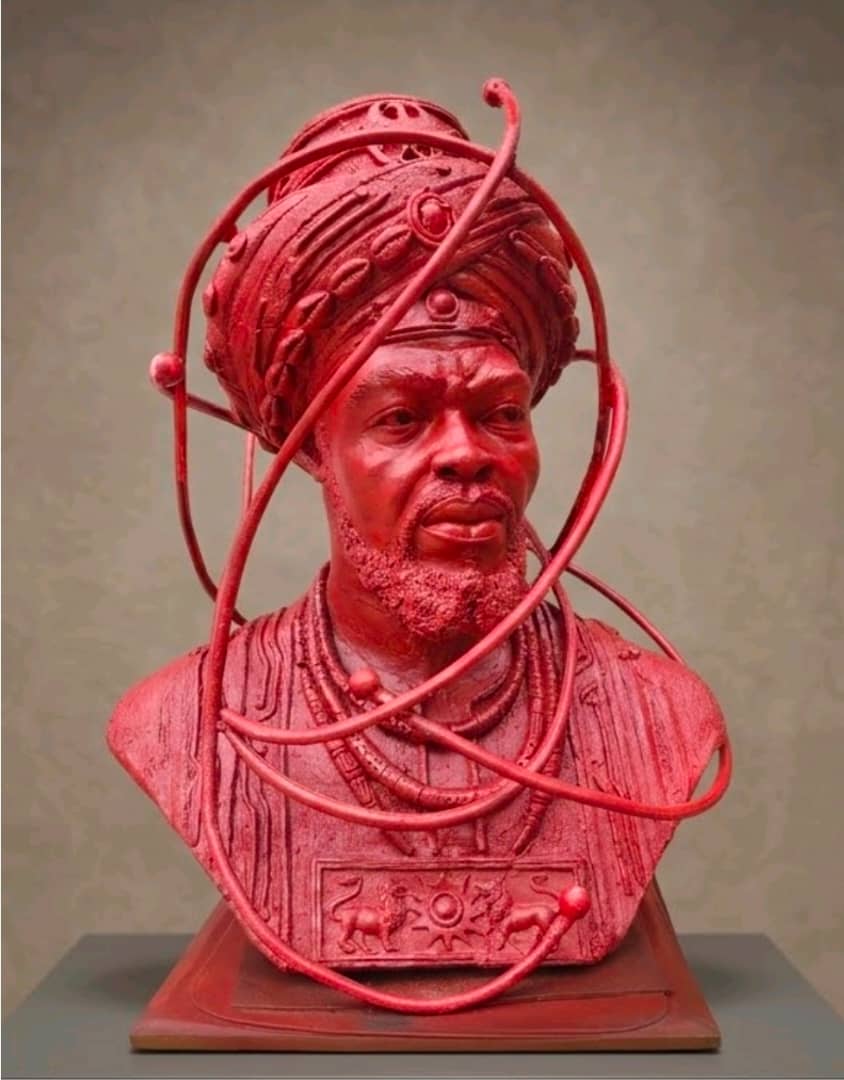
Among the works on display are Selfie, Mansa Musa, and The ultimate spectacle –the Linking between then and now. In Mansa Musa, Balogun presents a compelling encounter between African identity, cultural heritage and contemporary artistic expression. The work is a strong reminder of African empires of old and their rulers particularly Mali where Mansa Musa reigned. Through its striking portraiture, elaborate traditional attire and intricate network of looping forms, the work invites viewers to consider the relationship between history and the present, as well as the ways cultural identity is preserved, transformed and reinterpreted through art.
 The most immediate attraction is the sculpted bust of a man whose facial features convey dignity, maturity and quiet authority. His carefully modelled eyes, defined lips, prominent nose and textured beard give the portrait a sense of individuality and psychological presence. Rather than presenting an idealised figure, Balogun emphasises character and lived experience, allowing the face to become the emotional centre of the composition.
Apart from dominant red finish that gives the sculpture an arresting visual presence, Balogun’s decision to present an elaborate headgear is not only deliberate but significant. Its layered folds, decorative motifs and carefully articulated surface suggest the richness of traditional African dress, particularly the ways in which clothing can communicate social standing, cultural affiliation and historical memory. The multiple strands of beads around the neck reinforce this impression, creating a visual language of adornment that is both ceremonial and symbolic.
However, red carries multiple associations like power, vitality, sacrifice, spirituality and authority. In this work, it heightens the figure’s commanding presence while lending the sculpture an almost ceremonial quality. The monochromatic treatment also brings attention to the relief of the carved details, the texture of the beard, the folds of the headgear and the raised ornaments on the chest.
Ultimately, Mansa Musa’s strength lies in its attempt to bring traditional African portraiture into conversation with contemporary sculptural experimentation. It does not simply reproduce familiar cultural forms; it intervenes in them, surrounding the dignified figure with an unconventional framework that complicates how we read the subject.
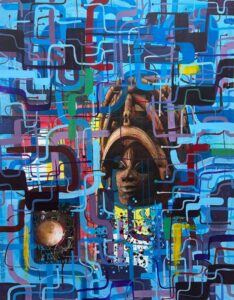
In The ultimate spectacle –the Linking between then and now, an artwork made from multiple mediums Balogun explores the relationship between cultural heritage and contemporary experience. At its centre is a sculptural-looking human face, framed by what appears to be traditional headgear, while a dense network of colourful, interlocking lines traverses the canvas. The contrast between the centrally positioned figure and the restless geometric patterns creates a visual dialogue between history and modernity.
Balogun uses the dominant blues, punctuated by black, purple, green, red and yellow to generate energy and movement. The maze-like lines may suggest the complexities of contemporary life, interconnected histories and the multiple pathways through which cultural identity is negotiated. Against this visual turbulence, the face emerges as an anchor of memory, suggesting the enduring presence of ancestral knowledge amid rapid social and technological change.
What stands out in the work is its layered visual language. Rather than presenting heritage as a relic, it positions cultural memory within the complexity of contemporary existence. Although the profusion of lines occasionally competes with the central figure for attention, this visual tension also reinforces the artwork’s apparent concern with negotiating the past in an increasingly complex present.
Over the years, Balogun has built a formidable reputation as an artist whose work in myriads of dimensions breathes new life into materials often considered obsolete. His sculptures animated with a remarkable sense of fluidity that transforms everyday objects into vibrant artistic statement, engaging critically with societal conditions, cultural memory and lived experience.
He has executed a number of public monuments which includes: Obafemi Awolowo bronze statue at the Oba femi Awolowo University, Ife, the Symbol of Culture and Justice, Unilag, Towards Achieving Distinction, U.I, Funso Williams’ statue, Tamed, Sweden, After the falcons, Abu Dhabi, UAE. and many others.
Balogun has held fourteen solo exhibitions, several group exhibitions, participated in residencies, conferences and facilitated workshops in Nigeria, Netherlands, USA, and UAE. He has received numerous awards both nationally and internationally. He is a Fellow of Society of Nigerian Artists (FSNA), and an active member of Sculptors’ Association of Nigeria. He is the Art Organizing Coordinator in Yaba Art Museum, Yaba College of Technology.