

By Olorunshola Osasona
As artificial intelligence (AI) continues to reshape the creative industry, arts and culture stakeholders have called on African artists to take ownership of their narratives and ensure that technology does not become another platform through, which the continent’s history and cultural identity are interpreted by others.
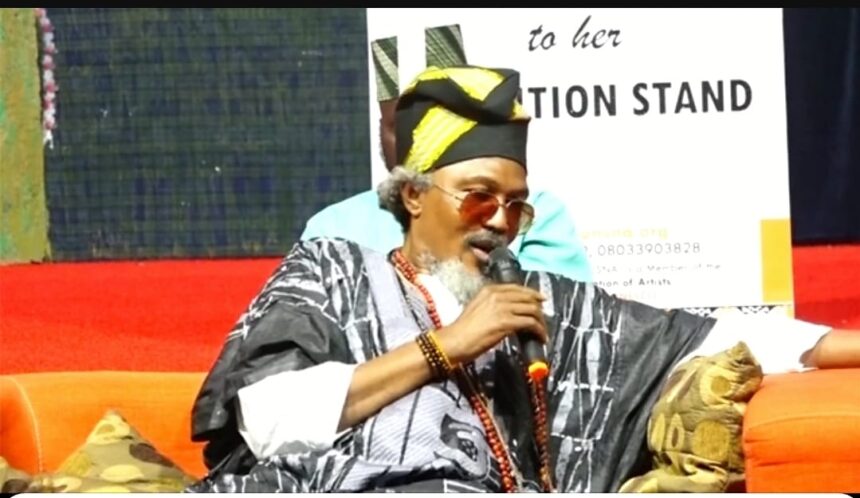
The call was made at the third edition of the Arts Expo and Exhibition organized by the Ogun State branch of the Society of Nigerian Artists (SNA), held at the Cultural Centre, Kuto, Abeokuta recently, with the theme Echoes of Creative Expression.
Olowu of Owu Kingdom, His Royal Majesty Oba Saka Adelola Matemilola, Otileta VII, who was represented by the Orunto of Owu Kingdom, Dr. Abiodun Lasile, at the event said Africa must urgently document and preserve its cultural heritage as the world moves deeper into the age of artificial intelligence.
Lasile said African languages, histories, oral traditions, proverbs, festivals, artistic expressions and indigenous knowledge must be properly documented, preserved and intelligently integrated into the digital age.
He described AI as a powerful tool that had come to stay, stressing, however, that humanity must remain at the Centre of the creative process.
“AI can be a powerful instrument. It has come to stay, whether anyone likes it or not. But humanity must remain the composer. AI cannot replace humanity,” he said.
According to him, the emergence of AI presents both an opportunity and a responsibility for Africans, particularly those who are custodians of the continent’s rich cultural civilization.
He warned that failure to preserve and tell African stories could leave room for incomplete or distorted narratives to be fed into AI systems, with the possibility that Africans could eventually encounter their own history through interpretations created by others.
“If we fail to tell our stories and preserve our cultural resources, others may feed AI with incomplete narratives and eventually return our own history to us in distorted forms,” he said.
Lasile also identified three critical areas he said Africans must prioritise in optimising creative expression in the era of AI: protecting originality, preserving cultural identity and developing ethical intelligence alongside artificial intelligence.
He explained that AI should enhance the creative mind rather than discourage the discipline of thinking, learning and creating.
On cultural identity, he said technology should serve as a vehicle for carrying African heritage into the future instead of erasing the distinctive identities of its people.
He also stressed the need for ethical responsibility, warning that creativity without responsibility could become manipulative, while technology without conscience could have dangerous consequences.
While urging artists to embrace AI rather than fear it, Lasile said those who refuse to take advantage of the technology risk expending more human energy on tasks that could be assisted by AI.
Dr. Ellis Adeyemo Oyekola acknowledged the growing importance of AI across artistic disciplines but urged stakeholders to adopt the technology responsibly.
Oyekola said AI provides artists with powerful opportunities to create, communicate and share ideas more effectively, adding that responsible use of the technology could result in faster, more innovative and productive creative processes without sacrificing individual artistic identity.
He argued that the objective should not be to replace human activity with AI but to combine human imagination with the speed and capabilities of technology.
“AI provides powerful tools for creative expression, but the result comes when human imagination and AI technology work together. AI teaches machines to perform intelligent tasks like humans,” he said.
According to him, effective use of AI requires artists and other creative professionals to learn how to combine technological tools with their own creativity.
He identified the ability to develop good ideas and provide clear instructions as an important component of achieving useful results from AI tools.
“A person who gives clear and detailed instructions is more likely to get useful and interesting results,” he said.
Oyekola, however, emphasised that creativity remains deeply connected to human imagination, emotions, experiences and personal values.
Dr. Mrs. Otunaiya Bola stressed the need of using AI to generate new ideas, explore new techniques, to make our ideas come to life, and to prepare the students for the future.
Head of the Fine Arts Department, Mountain Top University, Dr. Kehinde Shobukola, called for greater collaboration between artists and production engineers as part of efforts to move Nigeria from a consumption-driven economy to a production-oriented one.
Shobukola said artists, as initiators of ideas, and production engineers, as executors of those ideas, had complementary roles to play in transforming creative concepts into tangible products.
According to him, stronger collaboration between both professions would help translate artistic concepts and theoretical knowledge into physical products that could be mass-produced for the benefit of society.
He therefore called for reforms in the educational curriculum to create stronger links between classroom learning and practical production.
“What is taught in the classroom should be capable of becoming tangible physical assets,” he said, stressing that art should not merely be appreciated but should also be translated into products capable of contributing to economic development.
He said such a shift could help Nigeria transition “in every sense of the word from a consumption economy to production.”
Chairman Ogun State chapter Society of Nigerian Artists appreciated participants and stakeholders for their contributions to the success of the exhibition.
He urged artists and other stakeholders in the creative sector not to be left behind as AI continues to evolve, stressing that the technology should be viewed as an opportunity to enhance artistic practice rather than as a threat to the profession.
He maintained that AI was not designed to take away the jobs of artists but could serve as a tool for improving their productivity, creativity and capacity to compete in an increasingly technology-driven creative economy.
The exhibition, which brought together artists and other stakeholders in the creative sector, provided a platform for showcasing artistic works while also stimulating conversations around the future of creative expression in an era increasingly shaped by technology.