

ACETNEWS
Often, emerging Nigerian artists face more challenges trying to establish their own style than they do overcoming the hurdles of the technical side of their craft. That was one of the things brought to the fore during this year’s Life in My City Art Festival (LIMCAF). The jury appreciated the efforts put in by the artists and commended the quality of the submissions, but were critical of the works that unashamedly imitated what was popular at the galleries and prize-winning styles.
In its report for the 2026 competition, Open Letter, the six-member jury commended the high level of organisational competence and artistic integrity exhibited by entrants from the five regions, as evident in the clarity of the messages and the maturity of the figurative and technical representations of the works. It, however, charged regional coordinators to be more discriminating, to avoid the selection of replicas, repetitive works, and works already exhibited at previous editions. The jury also charged artists to self-consciously situate their identities in their immediate social and environmental realities and elaborate more on the complexion of their visual language to engender a heightened sense of personal style.
The comment appeared to be an evaluation of the competition’s broader aspirations, which go beyond yearly prize-giving. The target is to foster creative entrepreneurship and management across the arts industry, while building platforms for young artists and providing opportunities for learning. The 100 finalists, drawn from 17 regional centres, brought a diverse range of responses to the theme at the annual art festival.
The submissions explored themes of social, political, emotional, cultural, environmental, and personal issues through a variety of media including painting, drawing, textiles, mixed media, sculpture, ceramics, digital art, video, installation and photography. The jury complimented the ingenuity of some artists in the ways they utilized materials including fabrics, metal and aluminium scraps, mesh and waste paper.
This approach to art material was one of the many highlights of the exhibition. The nature of the art material industry in the country tends to limit the type and quantity of the materials artists, especially the young, can purchase. But the exhibition proved that scarcity of art materials need not be an impediment to invention.
There was however, a section of the report that was critical of some of the works submitted. The judges noted that despite the strength of the ideas presented in a number of the works, the applicants were unable to achieve a good level of detail in presentation, execution and finish of their work. To that effect, the judges recommended that clearly outlined terms of reference be strictly enforced during the regional selections and especially at the grand finale.
The six-member panel, headed by Chike Chinazom Obeagu, and comprising Talatu Adiwu Onkala, Frank Ugiomo, Ugochukwu-Smooth Nzewi, Bella Anne C. Ndubuisi and Dotun Popoola, assessed the works for their interpretation of the theme, creative use of materials, quality of finish and presentation, and originality of their visual language.
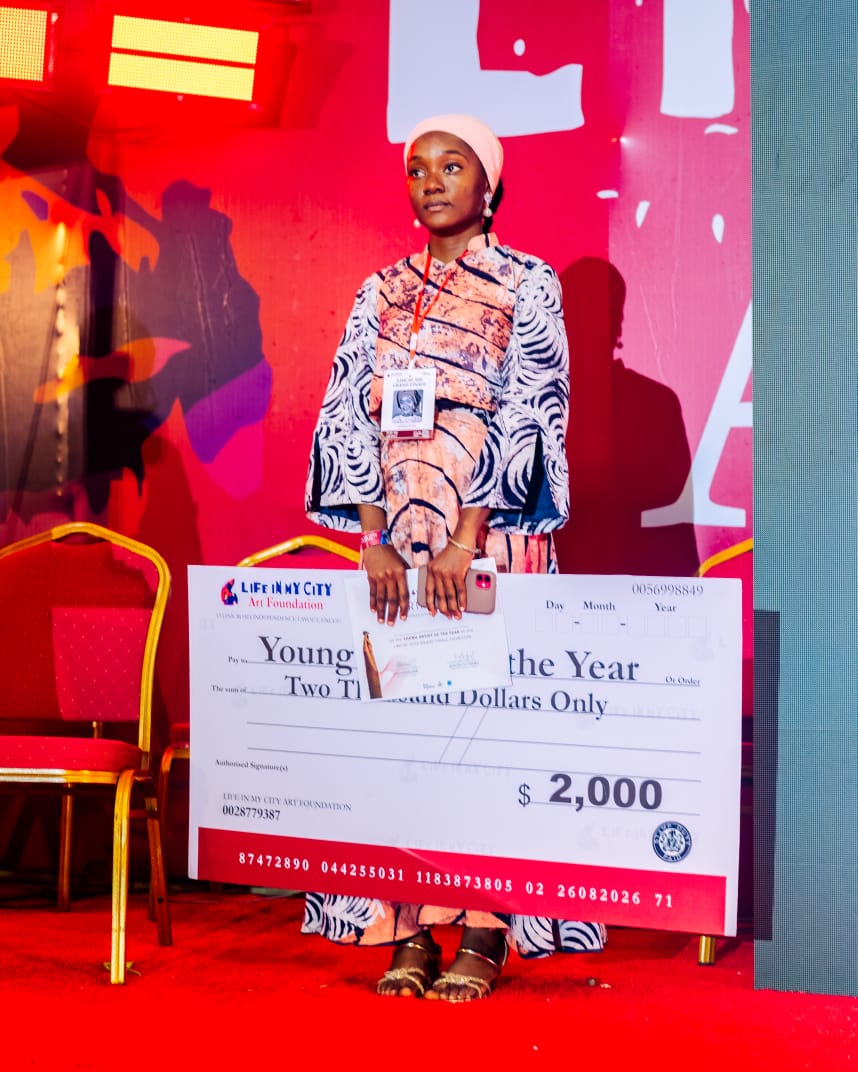
The Elder K.U. Kalu Prize for Young Artist of the Year worth $2,000, and the Grand Prize, was awarded to Bilikisu Oyiza Shuaibu for her work, Mai Kisto: A Million Tales. The work, made of beads connected with strings, illustrates women having their hair done in a beauty salon, and, because of its handling of materials, stood out among the other works displayed in the two-level lobby of the conference center auditorium.
Winners of other categories included Success Emeka, recipient of the Chinelo Chime Prize for Photography for The Tomorrow We Might Never See, and Kayode Oluwapelumi, recipient of the Capt. Everest Nnaji Prize for Best Painting for Open World: Where Everything Grows. Obeka Simon Edoh won the Tayo Adenaike Prize for Best Watercolour for Breaking Chains, Not Spirits.
Gushi Clinton Data won the Chief Alexander Orji Prize for Best Sculpture/Installation for How I Play My Part; Chimmuanya Onuzulike won the Best Ceramics for “Extraction”; while “Life” by Jacob Onyebuchi Onu won the Graphics, Digital Art and Video category. John Ojo won the Best Drawing for “Many Good Heads.”
Victoria Oluwadamilola Adewole won Best Textile Art/Fashion Art for To The Wounds That Refuse to Heal while Praise Edward won the Most Creative Female Artist for “Between The Lines of Inertia.” Taiwo Iyamu Shileola won the Artists Living with Disability category for “Open Letter to the Mind.”
Godwin Ejike Ugwuagbo won the Justice Aniagolu Prize for Originality for “The People’s Manifesto”. Ruth Ben won the Mfom Usoro Prize for the Best Entry from Uyo Centre for “The Rat Race” and Louis Ifeanyi Igwegbe won the Vin Martin Ilo Prize for the Best Entry from Enugu for “Every Feeling Leaves A Mark”. Hosea Timothy Dakas won the Chike Obeagu Prize for Best Collage for “A Letter Unread” and Augustine Martin Ebuka won the Stephen Bezalel Prize for “Green-White-Green Like Babel”.
Other awards went to “Que Sera, Sera” by Victor Ishaya, winner of the Agoreyo Armstrong Prize for Best Entry Wastepaper, and “Residue of Time” by Daniel Ogbodo, which won the Kanyeyachukwu Tagbo-Okeke Prize for Best Entry by a Special Need Artist. The Pius Okigbo Prize for Technical Proficiency went to “Prime” by Hannah Success Egba, an artist from Auchi.
The top six artists, Shuaibu, Oluwapelumi, Data, Adewole, Edward and Shileola, were given an all-expenses-paid two-week trip to Dakar, Senegal, courtesy of El Anatsui. Others received consolation prizes for their entries.
The judges recognised the professionalism and administrative tenacity of the organising committee and thanked the board members, sponsors and judges for their services. The judges also wished for the next edition to be themed, Emerging Frontiers, to nurture more adventurous and imaginative artistic expressions. For a festival that has devoted years to bringing young artists from different areas of Nigeria to a shared exhibition space, the judges’ advice is especially pertinent.
Godwin Ejike Ugwuagbo received the Justice Aniagolu Prize for Originality for “The People’s Manifesto”. Ruth Ben won the Mfom Usoro Prize for Best Entry from Uyo Centre with “The Rat Race”, while Louis Ifeanyi Igwegbe received the Vin Martin Ilo Prize for Best Entry from Enugu for “Every Feeling Leaves A Mark”. Hosea Timothy Dakas won the Chike Obeagu Prize for Best Collage for “A Letter Unread”, and Augustine Martin Ebuka received the Stephen Bezalel Prize for “Green-White-Green Like Babel”.
Other awards went to “Que Sera, Sera” by Victor Ishaya, winner of the Agoreyo Armstrong Prize for Best Entry with Wastepaper, and “Residue of Time” by Daniel Ogbodo, which received the Kanyeyachukwu Tagbo-Okeke Prize for Best Entry by a Special Need Artist. The Pius Okigbo Prize for Technical Proficiency went to “Prime” by Hannah Success Egba, an artist from Auchi.
The top six artists – Shuaibu, Oluwapelumi, Data, Adewole, Edward and Shileola – were also selected for the El Anatsui-sponsored two-week all-expenses-paid trip to Dakar, Senegal. Meanwhile, a number of other entries received consolation prizes.
The jury commended the organising committee for its professionalism and administrative resilience, and acknowledged the support of the festival’s board and sponsors. It also expressed the hope that the next edition, to be held under the theme Emerging Frontiers, would continue to encourage adventurous and original artistic expression.
For a festival that has spent years bringing young artists from different parts of Nigeria into a shared exhibition space, the jury’s admonition carries particular weight. The challenge is no longer simply to produce work that attracts attention or wins a prize. It is to develop an artistic language that can be recognised as one’s own.