

By Ozolua Uhakheme
Since April, 18 inmates of Maximum Custodial Centre, Kirikiri Apapa, Lagos, had the rare opportunity to hold a paintbrush, experiment with colours and create something meaningful. It also offered them more than an escape from the monotony of confinement behind walls. It didn’t only provide some freedom of expression of their talents, but also a chance to rediscover their abilities, rebuild confidence and imagine a different future beyond prison walls.
For over six months while still behind the walls of the centre, where daily life is defined by confinement, restricted movement and uncertainty about the future, the 18 inmates were discovering a new means of self-expression through art. And painting and other creative activities have thus become more than a pastime. They represent an opportunity to acquire skills, rediscover their identities and prepare for life after incarceration.
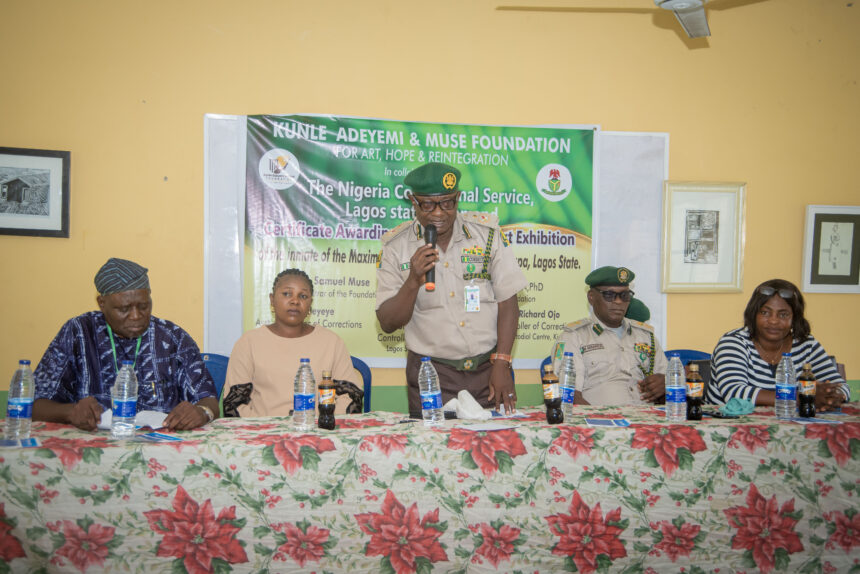
This golden opportunity came into focus at the certificate awarding and art exhibition ceremony organised for inmates who participated in the art training initiative introduced at the Custodial Centre in April this year. The programme, facilitated by Dr Kunle Adeyemi and Muse Foundation for Art, Hope & Reintegration led by Samuel Muse, began with 18 inmates. After seven months of instruction, practice and creative exploration, nine committed participants have completed the programme and presented a collection of artworks reflecting their growing artistic abilities.
Aside the works displayed at the exhibition, however, lies a more compelling story of personal determination and the possibilities of rehabilitation through creative engagement.
For some of the participants, the programme has opened a window to a future they might not previously have considered. Rather than seeing their present circumstances as the final definition of their lives, they are beginning to envisage careers as practising artists and economically productive individuals when they eventually regain their freedom.
Speaking at the ceremony, Adeyemi said the initiative was founded on the belief that creativity has no prison walls and that every individual, regardless of present circumstances, possesses the potential to discover and develop artistic abilities.
He described the graduation and exhibition as an important milestone in the effort to use art as an instrument of hope, rehabilitation, personal development and social reintegration.
Although the initial number of 18 participants has reduced to nine, Adeyemi said the commitment demonstrated by those who remained was encouraging, particularly as they were eager to continue their artistic development in subsequent training sessions.
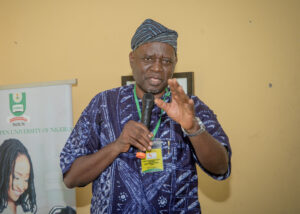
Their ambition, he noted, extends beyond learning to paint or produce artworks. They hope to translate the skills acquired into sustainable livelihoods and establish themselves as professional artists after their eventual release.
For individuals serving custodial sentences, the challenge of preparing for life outside the correctional facility can be considerable. Access to practical skills, opportunities for personal development and the prospect of economic independence can play important roles in making reintegration more meaningful. This is where the intervention seeks to make a difference.
Adeyemi acknowledged the cooperation of the management and officers of Maximum Custodial Centre, whose support made the programme possible. He also singled out two participants, Peter Jacob and Lawrence Ahigbe, for their dedication and assistance throughout the activities.
Despite the progress recorded, he identified funding and sponsorship as major obstacles to sustaining and expanding the initiative.
The programme requires regular supplies of art materials, a dedicated studio space, instructional books, production equipment and refreshments for participants during studio sessions.
He therefore appealed to government institutions, corporate organisations, philanthropic individuals, art patrons and foundations to support the project, stressing that investment in the programme would go beyond providing materials.
“We therefore appeal to government institutions, corporate organisations, philanthropic individuals, art patrons, foundations and well-meaning members of the public to partner with us. Your support will not merely provide materials; it will help rebuild confidence, nurture talents, create alternative livelihoods and prepare these individuals for meaningful reintegration into society.
“Our vision is to return next year with a bigger, better-equipped and more impactful programme, reaching more inmates and providing a sustainable platform through which artistic talents can be developed and transformed into viable careers,” he added.
According to him, such support would help rebuild confidence, nurture creative talents, establish alternative sources of livelihood and prepare inmates for meaningful reintegration into society.
The organisers are looking towards returning next year with a bigger and better-equipped programme that will accommodate more inmates and provide a sustainable platform for developing artistic talents into viable careers.
While appreciating the efforts of Adeyemi and his partners, Assistant Comptroller of Corrections (Welfare) Mr. J. A. Adeyeye, enjoined the inmates not to take the training for granted but make the beast of the opportunity. He added that many Nigerians are into arts and living big on it.
“Don’t let the efforts of our partners be n vain. Let them know you have been reformed and ready to reintegrate into the larger society when you leave the centre,” he added.
Some of the officers that attended the occasion were Comptroller of Corrections, Lagos State Command. Mr. George Daramola, and Deputy Comptroller of Corrections, Kirikiri Maximum Custodial Center, Mr. Sanmi Richard Ojo. `
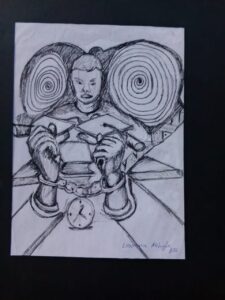
For the nine graduating participants, however, the immediate significance of the occasion lies in what they have achieved and the possibilities their new skills represent. They exhibited some thought-provoking drawings that depict their experiences and hope for the future. The works include Our facility volleyball court, by Lawrence Akhigbe, Leaf, by Eghosa Ebonhon, Putting my past behind me, by Lawrence Akhigbe, The way we are at Jankara, by Chukwu Ndubuisi, My Mirror self, by Chukwu Ndubuisi and The Cellmate by Dominic Peter.
Their artworks tell stories that extend beyond the prison environment. Each piece represents hours of learning, experimentation, patience and determination by individuals seeking to redefine their circumstances.
Indeed, the exhibition offers a reminder that incarceration should not extinguish the human capacity for creativity, learning and transformation.
“As we view the works on exhibition today, let us look beyond the physical objects and appreciate the stories of courage, hope, resilience and transformation behind them. These are not merely artworks; they are expressions of human potential and evidence that a person’s present circumstances need not determine his or her future,” Adeyemi noted.
As the country continues to explore more effective approaches to correctional rehabilitation, initiatives such as the Kirikiri art programme demonstrate the value of giving inmates opportunities to develop skills, express themselves and prepare for productive lives beyond incarceration. To these graduating artists, the prison walls remain a physical reality. But through art, they have begun to imagine a future that stretches far beyond them.