

By Ozolua Uhakheme
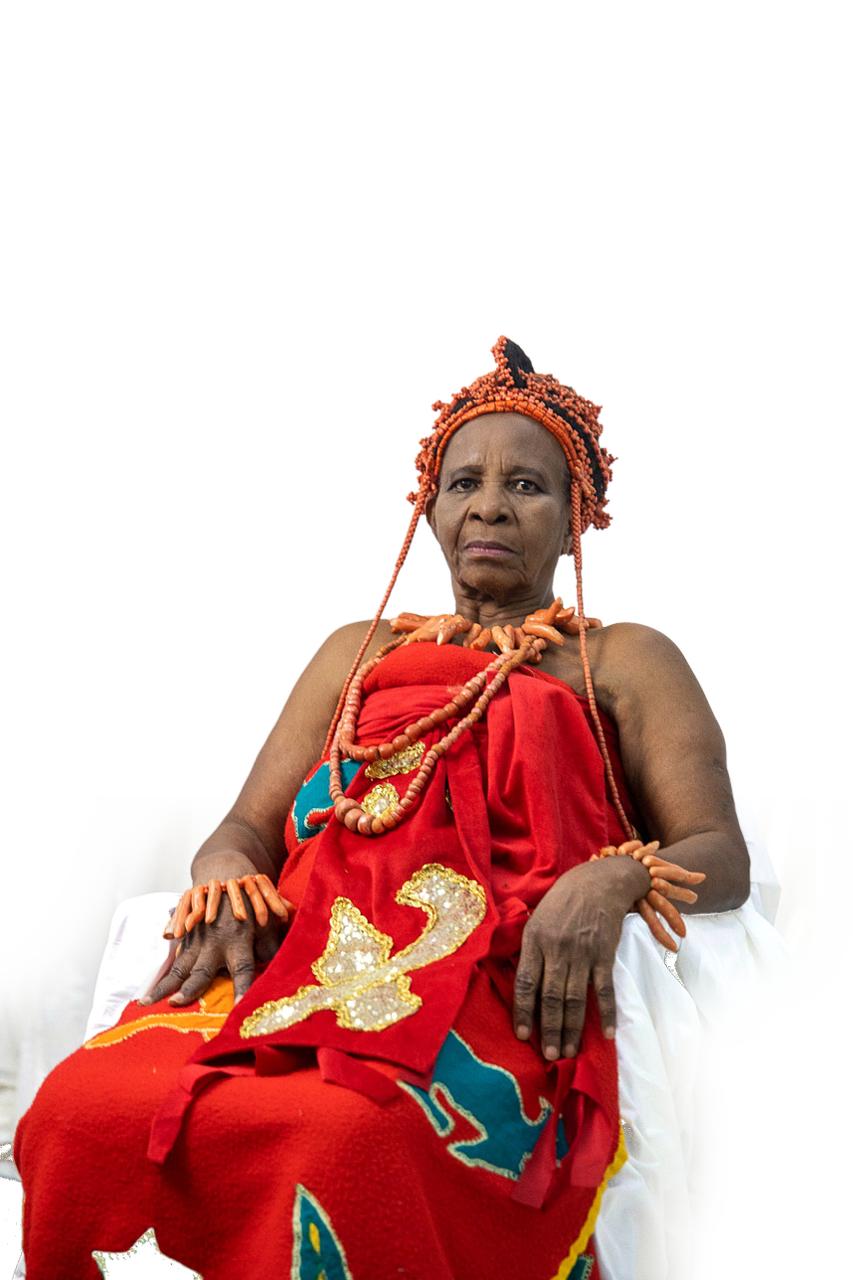
The passing of Princess Mrs Elizabeth Olowu (née Akenzua), a pioneer graduate of the Creative Arts Department of the University of Benin in 1979, marks the end of a remarkable chapter in Nigeria’s art and cultural history. An Amazon, trailblazer and mentor, her legacy lives on not only in her artistic and educational contributions but also in the lives she shaped, most profoundly that of her daughter, Prof. Peju Layiwola.
Late Princess Mrs Olowu who died on August 6, 2026, age 86, was Nigeria’s first female bronze caster, and daughter of Oba Akenzua II and Queen Ederaro Ehioba Akenzua.
Despite born into the royal household of Oba Akenzua II of Benin, she chose to be an artist whose professional career changed the trajectory of Nigeria’s contemporary art space. Rather than simply inherit that artistic legacy within which she was raised, she defied the odds to master it, and became a sculptor, educator, mentor, researcher and cultural custodian. Her life did more than leave memories, change the boundaries, reshape history, as she refused to inherit a tradition of discrimination particularly against the women folks at a period the age-long belief that “a woman does not cast bronze”, was an unchallenged tradition.
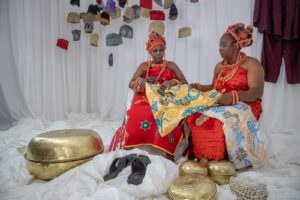
That sacred tradition was broken for her sake by the father. According to Benin History Project, ‘as a child Princess Elizabeth developed interest in the arts especially sculpture which was encouraged by her father. When she shared her desire to add bronze casting to her art, her father, a progressive king, decided to put traditions aside, entrusting the princess to the tutelage of the Igun Ẹrọnmwọn bronze casting guild who would teach her the noble art.’
In a deeply personal tribute, Prof Peju celebrates a mother whose influence transcended family, inspiring a legacy of knowledge, creativity, integrity and dedication that will endure across generations.
“No words were made for a loss like this! You were not only my mother but also my colleague, my partner, my mentor and my friend. So much of who you were cannot be captured in a simple biography. The moments we shared as mother and daughter will stay with me for the rest of my life.
“I could not have become the artist I am without you. You taught me that knowledge does not need permission to travel. I carry your ideas and ideals with me, and the rest of my professional life will honour all you invested and achieved.
“Thank you for a life lived in honour and truth, and for the hard work and dedication that never asked to be rewarded. The values you gave us live on in everything we do.
“As your eldest daughter, I am endlessly proud of your legacy. I carry it with your name: in the arts you loved, in the minds you shaped through education, and in the family you built and always held at the centre of it all.
“I am proud beyond words, and I always will be. The testimonies of your life are countless. Rest now. Your light stays with us,” she recalled with heavy heart.
The late Princess Mrs Olowu was of the pioneer set at Uniben Art School, where more than 4 of them were admitted into the first set. She and three others graduated in 1979 while the others passed out in 1980. Thus, she and the three males were the first graduates of the department. Interestingly, she was the only female in the cohort that was the first to graduate in 1979.
To her fifth and last son, Adetokunbo Osarobo Tunde-Olowu, the passing of the mother came with mixed feelings. On one hand, he was filled with sorrow that she is no longer with him, but on the other, it is with gratitude to Almighty God for the privilege of being her son.
“Mama, you were my first love, my first teacher, my pillar of strength and my forever treasure. How do I write a tribute to a woman whose love cannot be measured and whose sacrifices cannot be counted? How do I say goodbye to the one who gave me life, nurtured me, disciplined me, prayed for me and stood by me through every season of my life?
“You were more than my mother. You were my friend, my adviser, my protector and my comforter, and one of God’s greatest blessings in my life. You were beautiful in appearance and even more beautiful in character. You shared my joys, carried my burdens in your heart, and were a light that guided me whenever life seemed uncertain.
“You taught us that true beauty comes not from fine clothes or possessions but from a good heart, a disciplined life, a humble spirit and genuine care for others. You never tolerated dishonesty, laziness or disrespect, and you taught us never to look down on anyone, whatever their status. As children, we did not always understand why you were so strict. Today I do. Behind your firmness was a heart overflowing with love.
“Oh, Mama! Where will I find another mother like you, who will love me with the same tenderness, correct me with the same sincerity and pray for me with the same devotion? No one can ever take your place in my heart. When tears come because I miss you, I will remember how fortunate I was to be loved by such a remarkable woman,” he said, in his tribute, titled A Tribute to My Beloved Mama.
One of her fellow pioneer graduates, University of Benin, 1979 set, Tokunbo Browne recalled with nostalgia old memories of their days at the university. She noted that the lasting impression he had of her is 100% talent, 100% perspiration.
“You and I, together with Mr Ukpoki and Mr Okotie, share the privilege of being the first four Fine Arts graduates from the Department of Creative Arts, at the University of Benin, in 1979. Your commitment to your craft was second to none.
“I was young and impressionable, and you gave me advice that has had a lasting, positive impact on my personal life. We never met again after graduation, but I have been blessed to develop a professional bond with your daughter, Prof. Peju Layiwola, who is a true reflection of your industrious spirit,” Browne said.
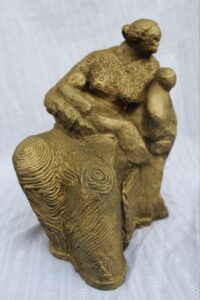
Princess Mrs Olowu studied sculpture and showed a rare readiness in investigating materials and methods that went beyond what is normally expected. Her experiments were not merely ways of carrying out her academic tasks; rather, they showed that she had a mind capable of noticing the potential inherent in materials. She was able to see in a common material another artistic possibility. A sculpture, which was created during her time as a student, depicts a woman sitting down and reading a book. This piece is remembered not only because of its subject but also because of its importance in the experimental atmosphere that existed in those early years.
Her work with polystyrene was especially noteworthy. Although the material is usually used as packaging for manufactured products, she made it a medium for artistic experimentation. She used it in the creation of architectural relief sculpture and, instead of viewing the material as only temporary, she further explored its sculptural potential. After she had graduated, she carried on with this area of investigation in her private studio in Benin City.
Her early years were spent at Eguae, the Oba’s palace, where she was drawn into art making from childhood. Surrounded by the palace artists at work, and immersed in Edo art, music and culture, she longed to make what she saw. She would later recall how profoundly this shaped her thinking. Her mother, a woman of many talents, moved effortlessly between crafts. She embroidered her husband’s handkerchiefs, beaded his shoes, and led the Oba’s other wives in painting and restoring the palace walls before major festivals. She was equally skilled at making women’s coiffures (Okuku) and weaving organic fibres into bags.
She attended Government Primary School, Benin City. After completing her Primary School Certificate Examination in 1955, she moved to Lagos in 1956 to attend Holy Child College, Ikoyi, under the strict tutelage of Catholic Reverend Sisters. confidence she exuded throughout her life.
At Holy Child College, she designed costumes for Christian plays and captured the picturesque scenes of Lagos by painting landscapes and seascapes. In 1960, she won Mr Obi’s Prize as the school’s outstanding art student and the Principal’s Merit Award for the best student in Fine Arts. After leaving Holy Child College, she attended the Federal School of Science, Onikan, Lagos, where she obtained her University of London General Certificate of Education in June 1964.
In 1965, she was hired as an art teacher at Anglican Girls’ Grammar School, Benin City. She taught there only briefly before gaining admission to the University of Nigeria, Nsukka, that same year. Sadly, the crisis that led to the Nigerian Civil War cut short her programme, and she had to return home to Benin City.
In 1966, she joined the staff of Itohan Girls’ Grammar School, where she taught art with rare mastery. She was indeed a master of crafts as much as of painting and drawing. All five institutions she taught in include: Anglican Girls’ Grammar School, Itohan Girls’ Grammar School, Federal Government Girls’ College, Benin City, the University of Benin Demonstration Secondary School and the University of Benin. Her methods shaped a generation of students, many of whom won awards in fine arts.
With six children and undiminished zeal, Princess Mrs Olowu became one of the four pioneering students who graduated in June 1979. The few other students admitted in the same pioneer class of 1976 graduated in 1980. She thus became the first sculptor and the first female art graduate of the University of Benin. In the 1977/78 session she won the prize for the best art student in the Department of Creative Arts at the University of Benin – the same prize her daughter who later became a professor of art received exactly a decade after. She finished with a second-class honours, upper division, Bachelor of Arts degree in sculpture.
She returned to the University for a Master of Fine Arts in sculpture, specialising in bronze casting, completed in 1984. In the 1981/82 session she taught the course “An Introduction to Sculpture” in the Department of Fine Arts at the University of Benin.
Two years stand out as turning points in her artistic career: 1966 and 1976. In 1966, she began learning to cast from a blacksmith whose workshop stood just outside the gate of Itohan Girls’ Grammar School, making small objects such as bells. That first experience left her wanting more.
In 1976, she told her father she wanted to learn the more complex traditional Benin lost wax casting method. He granted her request and asked the bronze casters to teach her. She was apprenticed to Chief Ugiakha Omorodion (d.1998) on Igun Street. She went on to become the first woman to cast bronze in Benin City, an art that had been reserved for men for centuries.
She set up her gallery and studio at 125 Sapele Road, Benin City, in 1977 and added a foundry in 1981. She dreamed of a modern studio and foundry with facilities like those she had seen at the Royal Academy of Art in The Hague, which she visited in 1978. Princess Mrs Olowu did not simply make wax models. She modelled, invested and cast her own work using the cire perdue (lost wax) technique. She also experimented with sand casting and continued to produce outdoor statuary in her studio.
Her talent cannot be confined to one category. She was a sculptor, textile artist, designer, crafter, costumier, performance artist, singer and culture enthusiast. In 1978, she designed and made the commemorative cloth, in two colourways, for the funeral of her father, Oba Akenzua II.
Her studio was a beehive of activity. For many years, it drew local and international artists, scholars, connoisseurs and students who came to learn and share knowledge about Edo art and culture. Her work has been studied by several scholars. In 1991, Betty LaDuke devoted a chapter to her in a book Africa Through the Eyes of Women Artists, which has a preface by Elizabeth Catlett.
She held several solo and group exhibitions. In 1985, she won the Bendel State Award for Art and Culture at Bendel Expo ’85 and took first place at the 2nd Tourism Expo in 1988. She also represented the state in the First Better Life fair held in 1988 at Tafawa Balewa Square organised by the First Lady, Mrs Maryam Babangida. She was a member of many associations, including Zonta International (Benin branch), the Holy Child’s College Old Girls’ Association (HCCOGA) and the Friends of the Museum, Benin City. She was also patron of the University of Benin Demonstration Secondary School Old Students’ Association.
Princess Mrs Olowu was strict and firm yet loving and kind. She was strong, graceful, simple, confident and fearless. She held herself to the highest moral standards, and she worked so hard that her children learnt to work just as hard. She was a gifted storyteller and a remarkable singer, and her voice carried Edo folk songs and praise songs throughout the house. She raised all eight children without any outside household help.
Service and Honours
Princess Mrs Olowu served the former Bendel State Government and later, Edo State in various capacities. She organised skills workshops for the unemployed and for market women to help them supplement their earnings, many of the training sessions were free of charge. She contributed immensely to Nigeria’s art ecosystem, particularly in Edo State. After a fulfilling teaching career of 35 years, she retired in 2001 but continued working in her studio.
In her last years, she received two more awards that brought her great joy. In 2022, she was honoured in the Art and Culture category at the International Women’s Day Gala sponsored by UN Women and held at the US Consul General’s residence in Ikoyi, Lagos. She attended in person and was celebrated by five female envoys for her immense contribution to the development of culture in Nigeria. They were the US Ambassador to Nigeria, the French Ambassador to Nigeria, the British High Commissioner, the German Ambassador to Nigeria and the Head of the European Union Delegation. In 2024, she was inducted into the Edo State Teachers’ Hall of Fame for her many years of outstanding service and dedication to education in the state.