


By Ozolua Uhakheme
Hamzat Olamide Keshinro’s sculptural practice demonstrates how an ordinary industrial material can become a sensitive language for speaking about people, emotion, community and everyday life. Working across wire, iron and cement, Keshinro is interested not simply in shaping materials, but in using their physical qualities to tell stories. In this body of wire works, line becomes his primary language. He bends, twists, knots, and layers wire until it begins to behave almost like a drawing lifted from paper into three-dimensional space.
The uniqueness of the wire works lies in the combination of solidity and emptiness. Keshinro does not try to fill all the figures with wire. Empty spaces remain in the works; that is why the collection of the sculptures looks fragile.
This quality is especially obvious in the sculptures, which depicts mental fatigue, overthinking, pressure, and inner struggle. The Weight Within, A Mind in Motion, Tangled Thoughts, and The Weight of Silence explore the inner experiences that cannot be observed from the outside. For instance, in A Mind in Motion, there is a sitting figure contrasting with a huge tangle of wire coming out from the head. The mess becomes the physical depiction of thoughts, memories, questions, and opportunities.
The posture is another feature that Keshinro often applies in his sculptures. The lowered heads, bent bodies, and resting hands convey the information without any need to depict details of faces. In The Weight of Silence, the sitting figure is heavy with thoughts, while the emptiness inside its body is full of all those thoughts that remain unspoken. However, in the sculpture Falling, the body is released and falls in the air. This piece shows the uncertainty and loss of control. However, at the same time, it demonstrates falling as a transitional stage of going from one place to another.
The sculptures are not only about inner struggle. There are several works about freedom, resistance, and collective power. In Breaking Point, there is a figure hitting a chain and breaking it. The artist shows wire that could be twisted and broken as a metaphor for overcoming limitation. In Voices Rising, the artist turns to the collective figure, where several people fight together. This work also illustrates the idea of the material: one strand could be twisted, but several strands united in a chain become more complicated to break.
In The Strength of Many, the artist turns to ants and their paths and shows cooperation, responsibility, and common purpose. With this work, Keshinro pays attention not to personal achievements, but to the small contributions in maintaining families and community.
Some other works include tenderness and belonging. In Between Us, there are two figures illustrating companionship and emotional presence, and in Becoming there is a pregnant woman who is both the creation of new life and the transformation of the woman. Where I Belong is a transparent wire house. This sculpture shows that the idea of belonging is not limited to the body, but could be extended to the building and the experiences of living in it.
There are also some moments of release in the collection. The Quiet Bird talks softly about the possibility and the opportunity to go in a new direction, and Rhythm of Freedom makes rigid wire turn into three dancing figures with sweeping skirts and raised arms looking almost weightless. The sculpture is perhaps the best illustration of the ability of Keshinro to transform the resistant material into material expressing movements. As he said, he makes hard material dance.
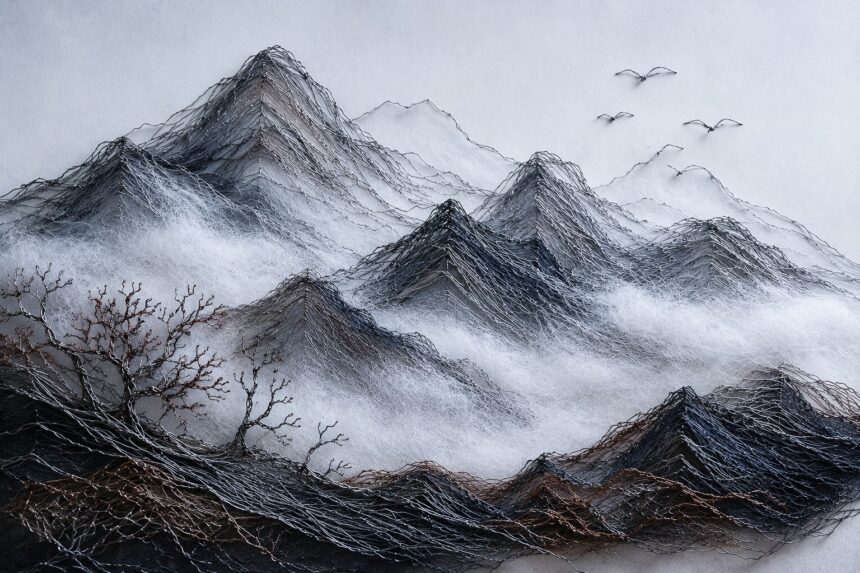
These works illustrate the artist who is interested in the contrast between the vulnerability and power of human beings. The wire could become a body, a thought, a mountain, a house, a chain, a community, and a gesture of freedom. The material looks handmade because the artist does not try to hide the twisting connections, overlapping strands, and irregular lines.
Instead of trying to make wire look like something else, Keshinro shows the material and the story together. The combination of these two aspects is the strength of the sculptures.