

By the time the Portuguese reached the court of Benin towards the end of the 15th century, they encountered and met a kingdom with a standing army, a court run on strict protocol, well-worn trade routes and a political order that had been in place for generations.
That is the premise around which Benin-Portugal: Encounters, Art & Cultural Exchange, the Ndikama Museum’s exhibition at the Nigerian Embassy in Lisbon, revolves. The timing of the exhibition, which opened on October 1 as part of the celebrations marking Nigeria’s 66th Independence anniversary, could hardly be more apt. It goes back to that first meeting and, in doing so, brings the civilisation behind the famous bronzes into focus.
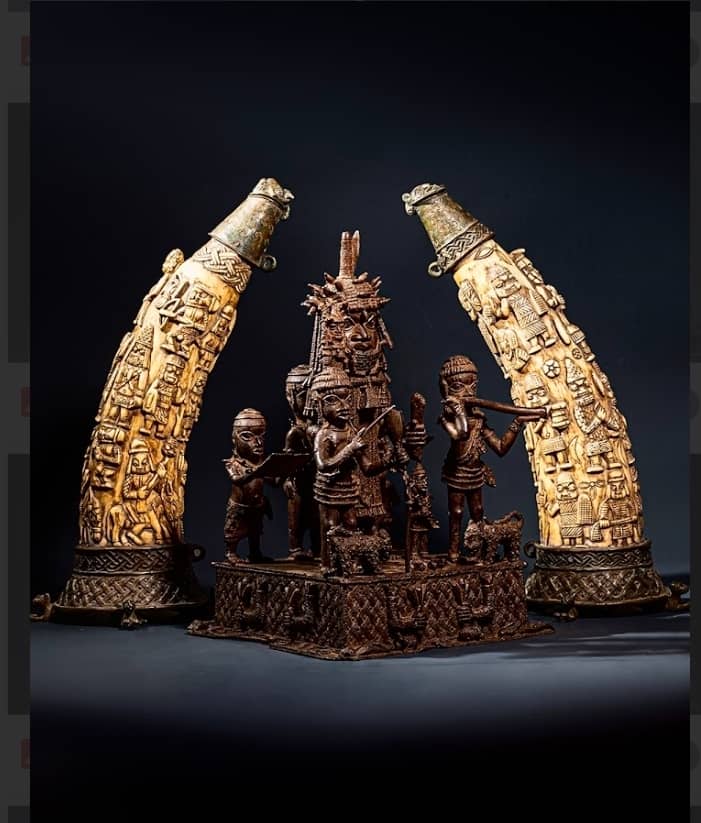
Talking about those bronzes, they are mediums through which viewers can get glimpses of that European contact with West Africa. Benin’s artists, it would seem, told their own story eloquently through them. It was just like the proverb Chinua Achebe made famous says
“Until the lions have their own historians,the history of the hunt will always glorify the hunter.”
It’s easy to see why the Portuguese appear in Benin art from the bronze sculptures displayed at the exhibition. Their presence also attests to the fact that the Benin court had contact with people from places far beyond its immediate surroundings. Viewers can see the Portuguese standing beside the Oba and his warriors, in hunting scenes and on objects made for the court. Some are shown by the Benin artists in their own distinctive style, with their weapons and other goods they brought with them.
Besides, the art was not only about men and their activities. It also included animals and other creatures with special meanings. Take the leopard for instance, it was associated with the Oba and royal authority. As for the elephant, it stood for strength and royal power while the crocodile and other creatures of the water were linked to Olokun, the deity of the sea who was believed to bring wealth and prosperity.
The encounter with the Portuguese also left its traces on religion and language. The fact that Christianity was introduced at the Benin court helps explain why a Bible in Portuguese was there before the British invasion. Portuguese was also used as a means of communication at the court, while some Portuguese words found their way into the local language. These may seem like small details compared with the famous bronzes. But they show that the relationship went beyond buying and selling. It also touched the language people spoke, the religion they practised and life at the royal court.
Then there is Queen Idia, the mother of Oba Esigie, who was traditionally regarded as the first Iyoba, or Queen Mother. She is remembered as a powerful political figure and a warrior. Her story shows that women could also play important roles in the political and military life of Benin. She was part of the world of power during Esigie’s reign, and her image and reputation remained in Benin’s art and memory long after.
The bronzes also show how people were ranked in Benin society. Visitors to the exhibition can see this in the way people are dressed, the way they stand, the weapons they carry and the objects they wear. The works show what rulers and warriors looked like and give an idea of how the kingdom understood power.
All this was before 1897, when British forces invaded Benin City, looted the palace and carried away thousands of royal and sacred objects. Many of them later, as history corroborates, ended up in museums and private collections in Europe and elsewhere. They became famous around the world, but were separated from the palace, the court and the religious traditions for which they were made.
The Lisbon exhibition looks at the period before all this happened, when Europeans were becoming part of the life of the Benin court through trade and diplomacy. The Portuguese were therefore only one part of the story of a kingdom that had existed long before they arrived. Much of that story can still be seen today in the brass, ivory and wood left behind by its artists.
The works featured in the exhibition preserve what rulers and warriors looked like, and the hierarchical system in the kingdom. These can easily be gleaned from the costume, gesture, weapons and regalia.
But all this was before things fell apart in 1897 when British forces invaded Benin City, looted the palace and carried away thousands of royal and sacred objects. Many of these looted objects ended up in museums and private collections across Europe and elsewhere in the West. They gained international fame, but at the price of being severed from the palace, the court and the religious traditions for which they were made.
Back to the Lisbon exhibition, which looks at the period before that rupture, when Europeans were being absorbed into the visual. A takeaway from it is that the Portuguese are one chapter in the history of a much older kingdom, and Benin’s own record of them survives in brass, ivory and wood.