

By Mudiare Onobrakpeya
There are artists who are forgotten, and there are those whose true importance simply takes time to catch up with them. I believe Erhabor Emokpae (1934–1984) belongs to the latter group.
Emokpae was far more than a painter. He was a sculptor, muralist, designer and advertising professional whose career ran through an important period in the making of modern Nigeria. His art entered private collections, but it also found its way into public buildings and national cultural projects. His association with FESTAC ’77 and major public commissions places him within the visual story Nigeria was creating for itself after independence.
Yet, for an artist of such breadth, Emokpae still appears insufficiently studied and, in my view, undervalued by the market.
One reason may be precisely his versatility. The art market likes a simple story. It is easier to promote an artist when one immediately recognises a particular medium or style. Emokpae was more difficult to contain. He painted, carved, designed and worked on a monumental scale. Some of his most important contributions belonged to public spaces rather than the auction room.
But there is another side of Emokpae that particularly interests me: the people who worked around him.
Art is rarely as solitary as we sometimes pretend. Behind many great artists is a studio culture—assistants, apprentices and younger artists learning by watching and doing. The master originates the idea, establishes the composition and directs the work, while other skilled hands may participate in its execution. This does not reduce the master’s authorship. It tells us something about the scale of his practice and his ability to transmit knowledge.
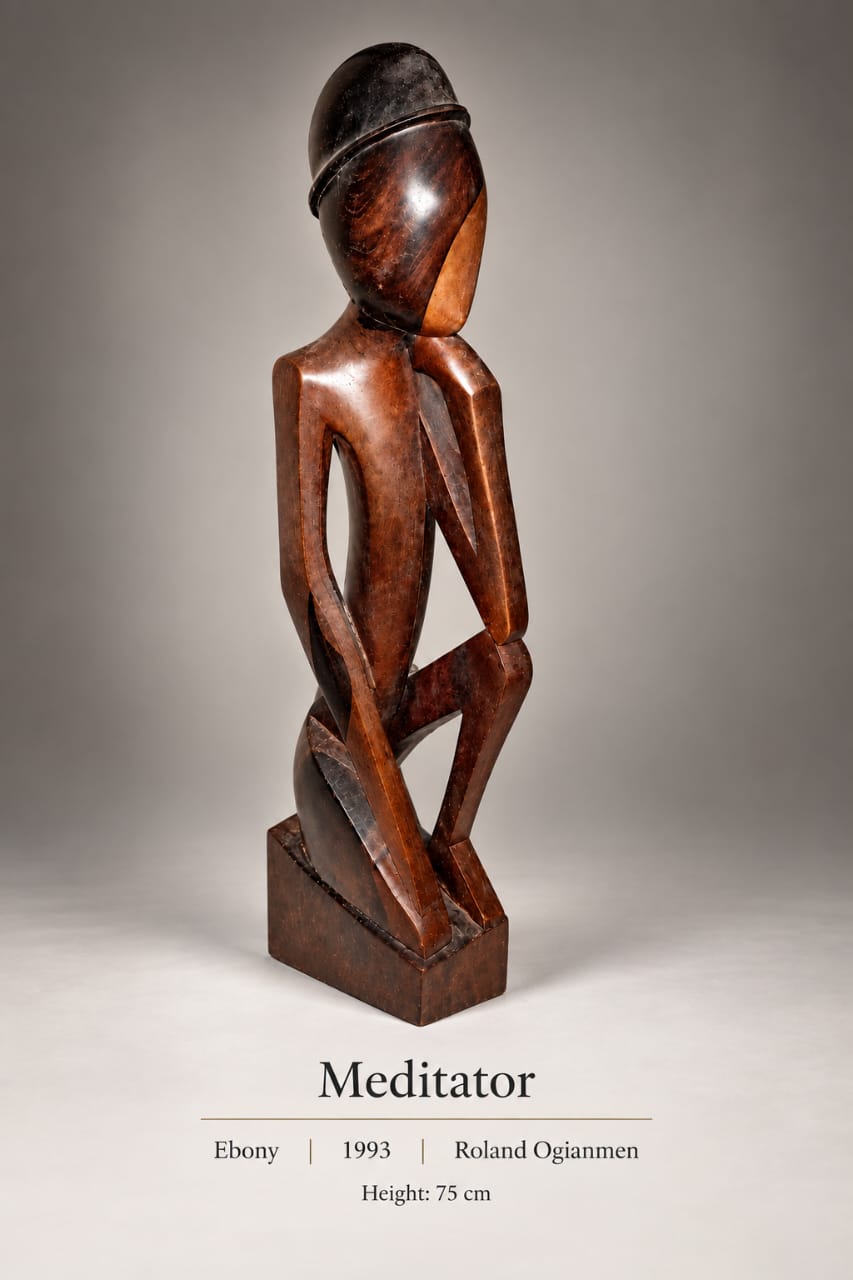
Roland Ogiamien is an important part of this story. His formative association with Emokpae is documented, and he subsequently emerged as an accomplished sculptor in his own right. Around the Emokpae studio are other names that I believe deserve much closer investigation: Monday Akhidue, Satuma Iyomana and Fred Achibong. We need to establish more precisely when they worked with Emokpae, what they did and, perhaps most importantly, what they carried away from the experience.
This is where I think a fascinating piece of Nigerian art history remains to be written.
Instead of asking only, What works did Emokpae leave behind?, we should also ask: Who did he influence? Who worked beside him? Who learned from his methods? And where did those ideas go afterwards?
Emokpae died in 1984 at only 49. That matters. He was denied the extra decades during which many artists consolidate their reputations through major retrospectives, books, museum acquisitions and sustained relationships with collectors. He left us the work, but perhaps not enough time to build the institutional structure required to keep telling its story.
For me, this is at the heart of the matter. We have looked at Emokpae’s works, but we have not looked deeply enough at the world around Emokpae.
A proper reassessment should bring together his paintings, sculpture, designs and public commissions, but it should go further. It should document what I would call the Emokpae lineage—Roland Ogiamien, Monday Akhidue, Satuma Iyomana, Fred Achibong and others whose stories may still be waiting to be recovered.
Do that properly, and I suspect we will begin to see Erhabor Emokpae differently: not simply as another important name from the first generation of Nigerian modernism, but as a master whose ideas travelled through other hands and continued beyond his own lifetime.
The measure of a master, after all, is not only what he leaves behind. It is also what he sets in motion.
*Dr. Mudiare Onobrakpeya