


By Mudiare Onobrakpeya
There are artists who inherit a style, artists who perfect one and the rarer few who create a language through which others may speak. Mufu Onifade belongs to this last category. His achievement is not merely that he developed a recognisable way of painting, but that he gave his experiments a name, a philosophy and, eventually, a community.
Born in 1966, Onifade studied Fine and Applied Arts at Obafemi Awolowo University, Ile-Ife. He emerged from an artistic environment in which tradition was neither treated as a relic nor accepted without question. At Ife, the intellectual foundations of Onaism encouraged artists to recover the motifs, patterns and philosophies of Yoruba culture and place them in conversation with contemporary life.
Onifade absorbed this inheritance, but he did not remain confined by it. He pursued his own experiments over several years, searching for a surface that could carry the density of Yoruba thought while retaining the immediacy of modern painting. The result was Araism.
The word àrà is particularly well chosen. In Yoruba, it can suggest wonder, astonishment or something extraordinary. Onifade also recast ARA as “Aesthetically Rich Art”. Yet Araism is more than an ingenious name. It is a visual method built around interlocking lines, fractured textures, layered colour and rhythmic patterns. Its surfaces recall the cracks on an old wall, the markings on tree bark, the intricacy of woven cloth and the resist patterns of adire eleko.
The paintings seem to have accumulated time. Figures, symbols and faces emerge gradually from their patterned grounds, as though memory itself were pushing through the surface.
After years of private experimentation, Araism entered the public space. Its decisive institutional moment came in July 2006, when the Araism Movement was formally launched at the Harmattan Gallery in Victoria Island, Lagos. Onifade exhibited alongside five of his early disciples, transforming what had begun as one artist’s studio discovery into a shared platform.
That event was significant. Nigerian art has produced many artists with unmistakable styles, but few have attempted to establish an organised movement around a newly developed technique. Onifade did more than protect his discovery as a personal trademark. He trained other artists, gave them room to practise the technique and invited them into the continuing argument of Araism.
This openness has also produced some of the most persistent questions surrounding his work. Is Araism a movement, a technique or an offshoot of Onaism? Does the presence of disciples establish a movement, or does it risk producing artists whose works resemble one another too closely?
These are fair questions. Indeed, they are necessary ones. Any artistic movement that hopes to outlive its founder must allow its followers enough freedom to depart from the master. If Araism becomes merely the repetition of crackled lines and familiar textures, it will gradually decline into decoration. Its future depends on its capacity to accommodate difference.
But the debate should not obscure Onifade’s central achievement. He took an artistic experiment, articulated its principles and created a system through which it could be transmitted. In a country where valuable artistic discoveries are often poorly documented and disappear with their creators, this act of organisation is itself an important cultural contribution.
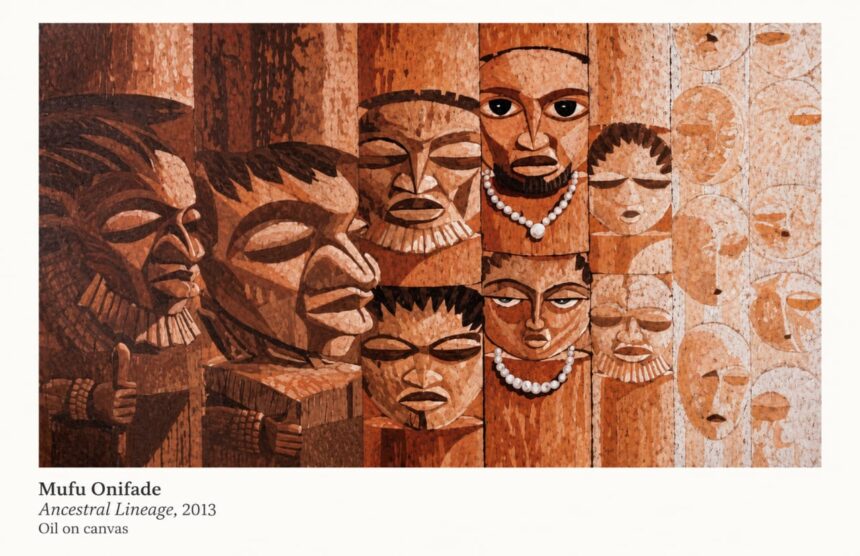
Onifade’s finest works demonstrate what Araism can accomplish when technique and subject are inseparable. In The Ancestral Lineage, painted in 2013, human heads appear within a richly worked field of lines and colour. The figures do not simply occupy the composition; they seem to rise out of it. Ancestors and descendants share the same pictorial space, suggesting that the past remains active within the present.
Here, texture is not an ornamental covering. It becomes a metaphor for inheritance. The painting reminds us that lineage is rarely a straight and unbroken line. It is layered, cracked in places, partly concealed and continually reconstructed by those who receive it.
Onifade’s work deserves closer attention from collectors and institutions. The Nigerian art market is often quicker to reward an attractive signature style than the intellectual labour behind it. A canvas may be admired for its colours while the years of experimentation that produced its language are forgotten. In Onifade’s case, the painting cannot be separated from the movement, the teaching and the argument about African artistic independence.
There is also something instructive in his refusal to accept the distinction between artist and cultural worker. Onifade has worked across painting, theatre, writing, criticism and cultural administration. This wider engagement places him within an older Nigerian tradition in which the artist was not expected merely to produce objects for sale, but also to contribute to the intellectual life of society.
Araism must now enter its next phase. Its disciples should be encouraged to challenge its founding vocabulary, apply it to unfamiliar materials and test it against the rapidly changing realities of African life. A movement honours its founder best not by copying him indefinitely, but by proving that his ideas can generate discoveries he did not foresee.
As Mufu Onifade approaches his 60th birthday, the occasion should invite more than congratulatory messages and ceremonial exhibitions. It should provoke a proper reassessment of his place in Nigerian art history. Six decades into his life, and nearly four decades after his earliest experiments, the artist has earned recognition not simply as the maker of textured paintings, but as a thinker who turned àrà—wonder—into a method, a movement and a durable contribution to modern Nigerian art.
At 60, Onifade’s story is far from complete. But the verdict is already taking shape: he did not merely find a style. He created a language and taught others how to speak it.
*Onobrakpeya is a proud collector of several works by artists of the Ara School and has followed the development of Araism with enduring interest.