



ACETNWES
The power of words, stories and ideas took centre stage in Lagos as Quramo Festival of Words (QFest) marked its 10th anniversary, bringing together writers, historians, artists, thinkers and literary enthusiasts for conversations on Nigeria’s past, present and future.
Held at the Grand Ballroom of Eko Hotels and Suites, Lagos, the anniversary edition provided an opportunity to reflect on the journey of a festival that began a decade ago as a one-day literary gathering but has grown into a wider platform for literature, theatre, music, performance and intellectual exchange.
Welcoming guests to the 10th edition, Pieces of Us, Founder and Chief Executive Officer of Quramo Publishing Limited, Gbemisola Shasore, said the festival was conceived to create a space where people could encounter new ideas while exploring the different ways stories could be told.
“When we started a decade ago, we wanted to create a gathering that transcended books. We aimed to establish a vibrant space where people could discover something new by integrating the arts, including theatre, music and performance, alongside stimulating conversations with writers and other brilliant minds, because everyone has a story to tell,” she said.
According to Shasore, the growing interest in the festival prompted the organisers to expand it from one day to two, three and, in some years, four days.
She said the expansion reflected the growing appetite among participants for knowledge, conversation and creative exchange.
“The programme grew because there was a thirst for knowledge and conversation,” she said.
For Shasore, the history of QFest is also connected to the history and character of Lagos. She explained that the festival has remained at Eko Hotels and Suites since its inception because of its proximity to Kuramo Waters, a place with a special connection to the Quramo story and from which the name was inspired.
She noted that Quramo had evolved from a fishing settlement into part of the wider economic and cultural landscape of Lagos, a city where people from different backgrounds converge in search of opportunities and prosperity.
She said that diversity mirrors the philosophy behind QFest, which has over the years created a meeting point for writers, readers, artists, thinkers and audiences from different backgrounds.
“QFest is also a place where people come together. People from different backgrounds, writers, readers, artists, thinkers and audiences, convene to share stories and ideas,” she said.
At the heart of the festival, however, is what Shasore described as a simple but powerful belief — that words matter. We believe that words germinate ideas, challenge assumptions and ultimately inspire change,” she said.
According to her, words have the ability to open conversations, challenge established viewpoints and give people the courage to confront difficult truths, including painful chapters in a nation’s history.
That philosophy informed the establishment of the Quramo Writers’ Prize, an initiative designed to encourage emerging writers, help them develop their craft and give their stories an opportunity to reach wider audiences through publication.
Shasore said the prize had also developed beyond Nigeria, attracting submissions from different parts of the African continent.
She cited Joan Wawira Thatiah of Kenya, who emerged first runner-up in 2019, and Arthur Gabriel Yak of South Sudan, who won the prize in 2024, as examples of the growing continental reach of the initiative.
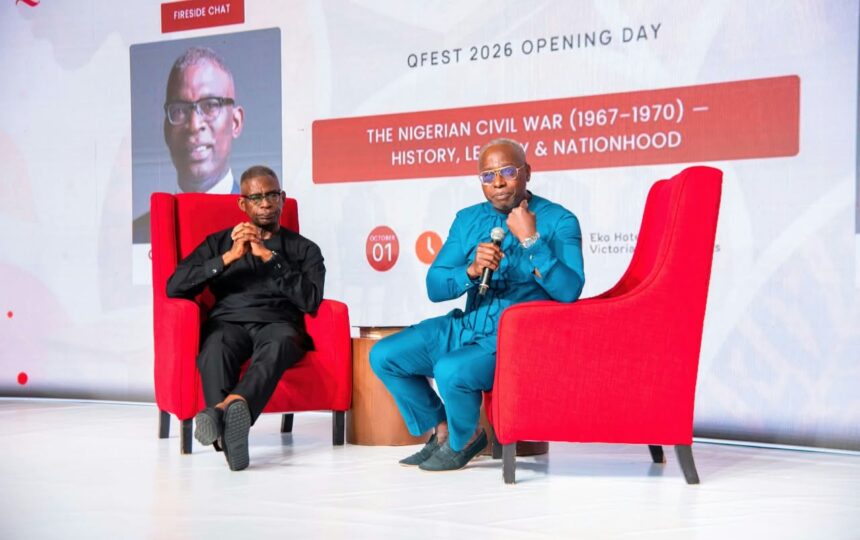
The festival’s 10th anniversary also provided an opportunity to revisit one of the most difficult chapters in Nigeria’s history — the Civil War of 1967 to 1970 — with speakers examining its origins, consequences and continuing implications for national identity.
Lawyer, African historian and documentary filmmaker, Olasupo Shasore, SAN, reflected on the conflict through the idea of “brothers” fighting brothers, stressing that the relationship between the people involved was as significant as the conflict itself.
He described the Civil War as “the story of brothers rising against brothers in the family field, aggravated by outside intervention.”
Nigerian historian, lawyer and documentary filmmaker, Nze Ed Emeka Keazor, also examined the war, focusing on its human cost and the need for Nigerians to confront the difficult questions of healing, forgiveness and reconciliation.
Keazor revealed that the Civil War segment followed a conversation he had with Mrs Shasore, during which they discussed the subject extensively and explored how it could be presented to festival audiences.
He said the effects of war should not be viewed only through military or political history, stressing that ordinary human beings ultimately bear the greatest consequences of conflict.
According to him, Nigerians must find ways to forgive and heal from the wounds of the past if the country is to move forward.
“The shooting war started on July 6, 1967, at Garkem, while its origins date back to 1962,” he said.
The Civil War discussion formed part of a wider programme that explored history, culture, community and identity, alongside contemporary issues affecting Africa’s literary and creative landscape.
The festival also featured conversations on homecoming and African culture, the cost of building a stronger reading culture and literary ecosystem, the experiences of African writers, the Benin Bronzes and African heritage, as well as the changing nature of storytelling in the age of digital publishing.
Mental health was also brought into the conversation, with the festival revisiting the issue of depression following audience demand. Poetry sessions, workshops and a film screening further broadened the programme.
Over the past decade, QFest has hosted a wide range of literary, cultural and media personalities, including Sefi Atta, Molara Wood, Eghosa Imasuen, Toni Kan, Mukoma wa Ngugi, Joke Silva, Femi Odugbemi, Jahman Anikulapo and Kadaria Ahmed.
The 2026 edition also featured prominent figures including former President Olusegun Obasanjo, lawyer and historian Supo Shasore, author Barnaby Phillips, novelist Vamba Sherif, literary advocate James Murua and writer Zukiswa Wanner, among others.
For Shasore, however, the festival’s 10-year journey is not the achievement of one person or organisation but the collective contribution of everyone who has participated in building it.
“QFest belongs to everyone who has given a piece of themselves to make it what it has evolved into,” she said, appreciating the writers, readers, speakers, moderators, facilitators, performers, partners, colleagues and others who have contributed to the festival over the years.
With its 10th edition theme, QFest’s anniversary offered more than a celebration of longevity. It reinforced the idea that stories can preserve memory, connect people across differences, challenge assumptions and create the conversations necessary for societies to understand themselves.
And after a decade of bringing people together through words, QFest appears set to continue doing what its founders envisioned from the beginning — creating a space where every story has a place, every voice can be heard and words can become a bridge between people, cultures and generations.