


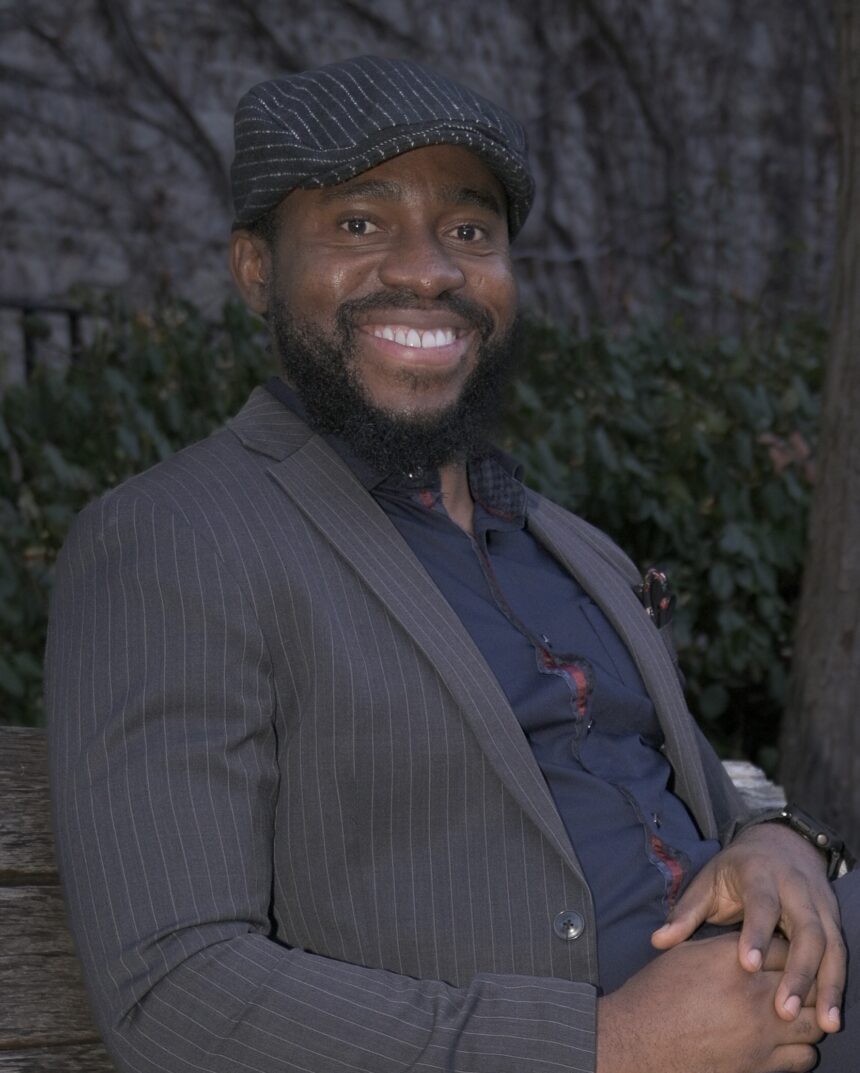

When Black Passport turns Akpomuje into migration scholar, poetry major
ACETNews
Once a beloved lecturer who gave students an open door and a listening ear, Dr. Paul Akpomuje is now using poetry to examine borders, belonging and the unbalanced experience of moving through the world as a Black African. Dr. Akpomuje, is not your typical Nigerian university lecturer.
Unusually approachable and an excellent and firm listener, he never needed to raise his voice, even with the most cantankerous of his students. His office was an open space and a sanctuary. Students could walk in to de-stress, talk through their problems, seek advice or simply catch their breath between lectures.
The office itself was not particularly large, but it was warm and inviting, always brimming with books, award plaques, conversations, and the occasional after-class pep talk.
At the Faculty of Education, Obafemi Awolowo University, Ile-Ife, Dr Akpomuje was popular among students and respected by fellow lecturers. His reputation travelled well beyond the faculty. For many of us, he provided respite when university life became overwhelming. He lent his sturdy shoulders to weary students. We saw him not merely as a lecturer, but as a brother, teacher, listener, mentor and comrade.
I was therefore delighted when I learnt that he had been long-listed for the CORA-NLNG Nigeria Prize for Literature for his poetry collection, Black Passport: A Migrant’s Memoir. But, beyond the pride of seeing a former lecturer recognised nationally, the book struck a deeply personal chord with me.
The teacher I remember
I took Dr Akpomuje’s Community Development course in my third year at OAU. It was one of those courses that students genuinely looked forward to. We would troop into an often cramped and poorly ventilated classroom, yet somehow the discomfort never diminished our enthusiasm. One thing that particularly impressed me was that Dr Akpomuje remembered everyone’s name.
It may seem like a small thing, but to me, it was one of the hallmarks of a good teacher.
People have different strengths, memory capacities and abilities to retain details. But, teaching is one of humanity’s oldest and most consequential professions. The people sitting in a classroom are not simply names on an attendance sheet; they are individuals whose lives a teacher has the opportunity, like a potter to mould. I have always believed that, by virtue of the brain’s plasticity, remembering the names of those whose minds you are helping to shape is itself a form of care.
Looking back, Community Development was also different from many of our other courses because it extended beyond the classroom and offered some real time, practical learning.
Dr Akpomuje took us on a field trip to a remote community out of Ile-Ife, where we were introduced to the practical meaning of community, the currency of simplicity and the value of honesty and trust.
As expected of someone whose coordination was almost always meticulous, the trip went remarkably well. There were no major glitches or hiccups. We learnt among other things, how to administer first aid and provide support for teenagers and how to observe the social and economic life of a community.
One lesson has stayed with me.
In the village, farmers displayed their produce in the market and went about their daily activities without necessarily remaining beside their goods. Buyers could take what they needed, leave the appropriate payment and go. The farmers returned later to find that the system of trust had worked.
It was humbling.
The people we might have described, from the perspective of the city, as “provincial” or unsophisticated seemed in that moment to possess something many urban societies and “civilized people” struggle to preserve: trust.
Years later, reading Black Passport, I found myself returning to that memory. The book is also concerned with communities, movement, belonging and the values that survive or disappear when people cross borders.
Reading Black Passport
Black Passport is, as its subtitle suggests, a migrant’s memoir in poetry.
The collection documents the experiences of Nigerian migrants navigating life in Canada, moving through immigration offices, airports, cities and classrooms while negotiating questions of identity, belonging and home.
But this is not simply a collection about relocation.
It is about what happens when the body becomes the subject of close scrutiny at a border or an airport; when a passport becomes a proxy for assumptions about a person’s intentions; and when movement, something that should be ordinary, becomes a privilege determined by the colour of one’s skin and the nationality printed on a travel document.
Brittle Paper describes the collection as an examination of how “borders, paperwork, and diasporic placemaking shape identity and belonging.” It also highlights Akpomuje’s engagement with the biopolitics of Black African migration, surveillance, bureaucracy and the everyday experience of being treated as perpetually foreign.
That description captures much of what makes Black Passport compelling.
Yet the collection is not entirely bleak. Akpomuje moves between pain and humour, memory and displacement, frustration and tenderness.
In “Japa”, for instance, the use of Pidgin gives the familiar Nigerian migration phenomenon a humorous, more intimate voice. Elsewhere, poems such as “For My Grandmother” turn towards memory and home, reminding the reader that migration is not only about where one goes but also about the people and places one carries along and leaves behind.
As poet and scholar Uchechukwu Peter Umezurike observes, the collection offers “a multifaceted portrait of African migrant experiences in North America,” revealing the bio-political forces that shape bodies, movement and space.
Chigbo Arthur Anyaduba similarly notes that Akpomuje gives readers more than the lamentations of a Black Nigerian migrant in Canada; he creates moments that allow us to laugh and squint at the same time.
That mixture is important.
Migration can be painful without being devoid of humour. Displacement can be traumatic while still producing moments of absurdity, tenderness and hope.
“Look, See a Daddy“
My favourite poem in the collection is Look, See a Daddy.
The poem captures something deceptively simple: the charming innocence of children before adults teach them the social meanings attached to race.
In the poem, children at a kindergarten see Akpomuje simply as a “daddy.” They do not initially see a Black man, a migrant or a foreigner. They see a human being occupying a familiar role.
The distinction is profound and deeply touching.
Children are not born carrying the elaborate racial hierarchies that adults construct. They encounter people first as people. It is often through socialisation that colour, nationality, class and other categories become attached to human beings and begin to determine how they are perceived. The poem therefore becomes more than an observation about children. It becomes a meditation on how societies teach people to see difference.
There is something particularly moving about the contrast between the child’s innocent gaze and the adult migrant’s scorn of borders, airports and immigration bureaucracy.
A child can look at a Black man and see “Daddy.”
An immigration officer can look at that same man and see a passport, a nationality, a potential over-stayer or a problem to be assessed and potentially avoided.
When the passport becomes the problem
The book’s exploration of airports and immigration bureaucracy resonated painfully with me because of my own recent experience.
Last year, I was selected as the only journalist from Africa to participate in and report the Global Development Conference in France. I was unable to attend because my visa application was rejected.
By then, the conveners had made the necessary preparations: my hotel had been booked, my flight arrangements had been made,travel insurance paid, I had been sent the relevant invitation and supporting document. Yet, I was told that I had not sufficiently convinced the consulate that I would return to Nigeria after the trip.
The rejection was devastating.
I struggled to understand how a professional invitation, legitimate journalistic assignment and carefully assembled documentation could still be insufficient to establish my intentions. I appealed the decision, but the rejection remained.
Reading Black Passport brought that experience back to me.
The book helped me understand my disappointment not simply as an individual rejection but as part of a much larger and deeply unequal system of mobility in which the passport one carries can determine the doors that open, the questions one is asked and, sometimes, whether one’s legitimate ambitions are even believed.
The passport becomes more than an identity document. It becomes a judgement.
When Africa closes its own borders
Perhaps one of the book’s most uncomfortable questions is not directed only at Europe or North America.
There have been conversations about countries such as Namibia and South Africa, where immigration restrictions can make movement difficult for fellow Africans even as citizens of some countries in the global west encounter fewer barriers.
This creates a troubling contradiction for a continent that continues to speak about Pan-Africanism, regional integration and the free movement of people, goods and services.
What does Pan-Africanism mean if an African travelling from one African country to another must confront the same anxiety over visas, borders and documentation?
What does African integration mean when a Nigerian needs a visa to enter countries such as Namibia or South Africa?
These questions matter because migration is not merely a European or Western problem. African countries are also active participants in systems of mobility control.
The continent cannot meaningfully advocate the free movement of Africans while simultaneously maintaining policies and practices that make Africans strangers to one another.
It is therefore a not only call to action for Western countries to open their borders to Africans. It is also that African countries must examine their own migration policies and build systems that support genuine continental mobility rather than reproduce hierarchies that privilege certain nationalities over others.
From scholarship to poetry
At the CORA-NLNG Nigeria Prize for Literature event, Akpomuje reflected on what being long-listed meant to him.
He recalled receiving recognition for his poetry as a student at OAU and remembered the encouragement of Prof Gbemisola Adeoti, who described him as a “budding poet.”
That early affirmation stayed with him.
Although he had not devoted as much attention to poetry in recent years, the long-listing has encouraged him to take the craft more seriously. For Akpomuje, the recognition is particularly significant because of his academic work. As a migration scholar and a teacher concerned with social justice in the Faculty of Education, he sees poetry not merely as an artistic exercise but as another way of producing knowledge.
That idea is important.
Academic research can provide data, theory and analysis. Journalism can investigate and document. Policy can translate evidence into action. Poetry can sometimes do something none of these forms can quite accomplish: make us feel the human weight of an idea.
As he pointed out, Akpomuje’s use of poetry as pedagogy—using poems to explore questions of migration, identity, justice and belonging—therefore feels like a natural extension of the teacher I remember. The lecturer who once took us outside the classroom to learn about community is now using poetry to take readers beyond the borders of their own experiences.
A book about movement, but also belonging
Ultimately, Black Passport is not only about migration. It is about the human desire to move, belong, return, remember and be recognised as fully human wherever one finds oneself.
It is an archive of displacement, but also of resilience.
It records the bureaucratic indignities of migration alongside the humour of “Japa”, the tenderness of family memory and the persistence of hope. It asks what happens to identity when people cross borders and what happens to belonging when the places we call home are separated by oceans, paperwork and suspicion.
For me, however, reading Black Passport has also been a reunion of sorts. I encountered the book not only as a reader but as a former student encountering the intellectual evolution of a teacher who once taught me that community could be understood by leaving the classroom and observing how people lived.
Years later, his poetry has offered another field trip, this time through airports, immigration offices, classrooms, cities and the complicated terrain of Black migration.
And perhaps that is the most fitting way to understand Dr Paul Akpomuje’s journey from teacher to migration scholar to poet.
He has always been interested in people, their communities and the forces that shape their lives. Black Passport simply takes that classroom much further.